
With the weeks dwindling till another Person of the Year is selected, some reflection is due on what the title means, what it once meant, and whether our understanding of it needs to change.

Designed by Jojo Teri
As is my custom to note, this post does not reflect the views of the CPA Wiki, only my personal perspective. Also, please forgive the obnoxious use of alliterative subheadings. It’s Rosaferri’s fault. Blame her.
Opening Observations
When I first entered the army community almost nine years ago, ‘Person of the Year’ did not exist. That is to say, it had once existed, but there was no major organization presiding over the community to decide who should receive the title. It was a radically different landscape, the likes of which had not been seen for many years. The landscape today is equally different from the days of Club Penguin Army Central during the OG Era, and from the org-less periods of 2017/2018 during which I first discovered Armies. Person of the Year is once again an annual event, and has taken a consistent form since its return under Club Penguin Army Hub in 2020.
Person of the Year is hardly an original concept. It derives from the annual selection made by Time Magazine to highlight someone or something said to have had the most significance or influence during the year. Person of the Year is not always awarded to just one person, and in some cases not even to a person at all. In 2022, the ‘Spirit of Ukraine’ was recognised in addition to Zelensky in light of the War in Ukraine. For 2025, eight leading tech CEOs, from Elon Musk to Mark Zuckerberg, were collectively recognised as ‘The Architects of AI’.
Today, I hope to consider how Person of the Year has changed since it was first conducted by Club Penguin Army Central in 2012. There will be some reflection on the evolution of its real-world counterpart. We will look at how the process balances success with notoriety, whether these two factors alone are sufficient to deem someone a worthy Person of the Year, and whether the CPA process has lost its way. Most crucially, we will bring to light a fundamental difference between the source material and what POTY exists as here in CPA, and why this has to be changed.
The Initial Inspiration
Time Magazine first selected a ‘Man of the Year’ for 1927. The cover featured a portrait of Charles Lindbergh for his successful solo transatlantic flight that year, the first person to ever do so.
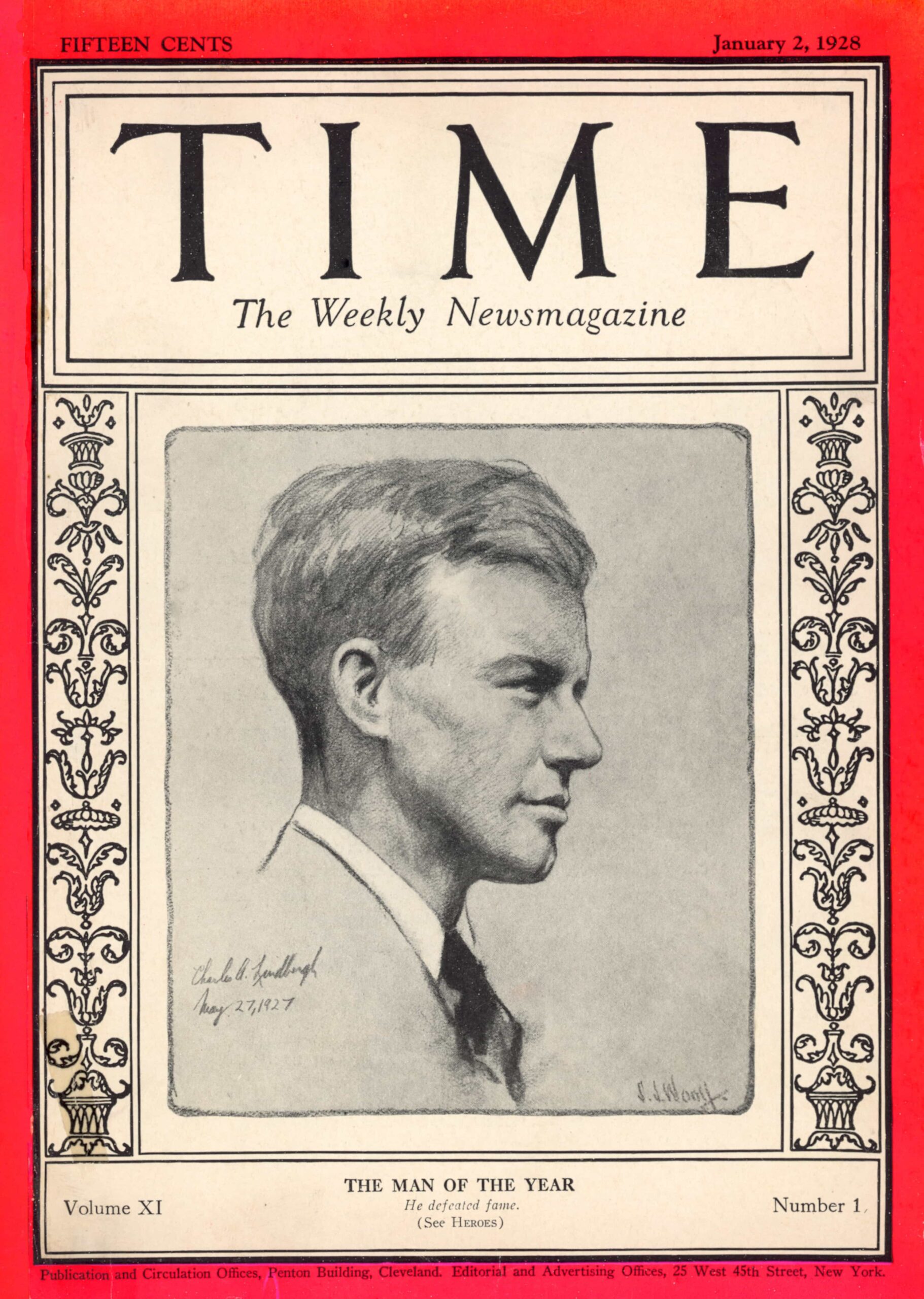
The cover of Time Magazine for its first-ever Person of the Year
Though the first edition focused on a man’s achievement, subsequent editions would favour other factors and place greater emphasis on overall influence, regardless of this being positive or negative. In 1936, Time recognised Wallis Simpson as its first-ever Woman of the Year, following her influence on King Edward VIII’s abdication in the UK. Just two years later, Time named a figure whose influence on the globe can only be seen as cataclysmically negative in the decades since: Adolf Hitler.
Hitler was selected as the POTY of 1938, predominantly for the annexation of Austria into Germany’s rule and the shockwaves felt by Kristallnacht, a night in which hundreds of innocent Jewish German citizens were murdered. Many significant things closely associated with Hitler had yet to occur, however.
Most apparently, the Second World War was a mere storm cloud on the horizon, and certainly not a conflict that America had any plans of being involved in. Poland remained a sovereign state, and would be as such for another 9 months from Time’s announcement. Though the first three concentration camps had been constructed, the Holocaust wouldn’t begin until Operation Barbarossa in 1941, during which 1.5-2 million Jewish people within the Soviet Union were murdered by Nazi German soldiers.
It is important in understanding Time’s process and decision to make this separation between what had happened and what was yet to come.
Hitler was far from Time’s first controversial figure to be selected, or the last. Stalin was selected in 1939 and 1942. Discussion of Stalin has been avoided for brevity, but the case of his two selections could also be discussed in relation to Blue’s statements by other writers.
Wikipedia suggests that Time started to avoid controversial figures following the financial losses caused by their selection of Ayatollah Khomeini for 1979’s POTY. Khomeini had become Iran’s first supreme leader that year, and the Iran Hostage Crisis commenced in November of that year. The decision to select Khomeini proved very unpopular with Time’s readers, though the magazine insisted that the title was not meant to glorify or honour him and only recognize his influence. Certain later years seem to reflect this trend, most notably the selection of Rudy Giuliani, New York’s Mayor, in 2001 in the wake of the 9/11 terrorist attacks in the city. Giuliani was selected over Osama bin Laden, who, by strict adherence to Time’s originally declared metrics, would likely have been the objectively accurate choice.
It’s possible to see this sort of approach earlier on, especially with World War Two and Hitler. Hitler was never made Person of the Year for initiating the war, or for his influence on the Holocaust occurring. Instead, the award went to others, including Stalin in two cases and American leaders such as Truman in 1945, who decided to drop the atomic bombs on Hiroshima and Nagasaki.
More recent years seem to indicate a closer adherence to Time’s stated purposes. Vladimir Putin was selected for 2007, following the assassinations the previous year of two of his most vocal critics. Though it is Time’s convention to select the newly-appointed US president each time one is elected, it is impossible to overlook the substantial controversy surrounding Donald Trump, selected in 2016 and 2024 following his election and re-election, respectively.
2025’s selection, the aforementioned ‘Architects of AI’, perhaps best encapsulates Time’s originally stated purpose. AI is arguably one of the most significant developing fields of the past few years, progressing in leaps and bounds and in ways that no one can accurately predict. It is shrouded in controversy and criticism, but could also significantly benefit humanity as a species. The selection therefore embodies both positive and negative influence on an immeasurable scale. I would posit that this selection reflects what POTY should set out to accomplish.
Having given extensive context on how the real Person of the Year operates, let us now return to the realm of penguins.
The Penguin Parallel
Club Penguin Army Central (CPAC) named their first Person of the Year for 2012. Direct inspiration was taken from Time, as evidenced by the ‘cover’-style thumbnails used for each edition’s post. It followed a Top Ten format, ultimately naming Waterkid100 as the winner.
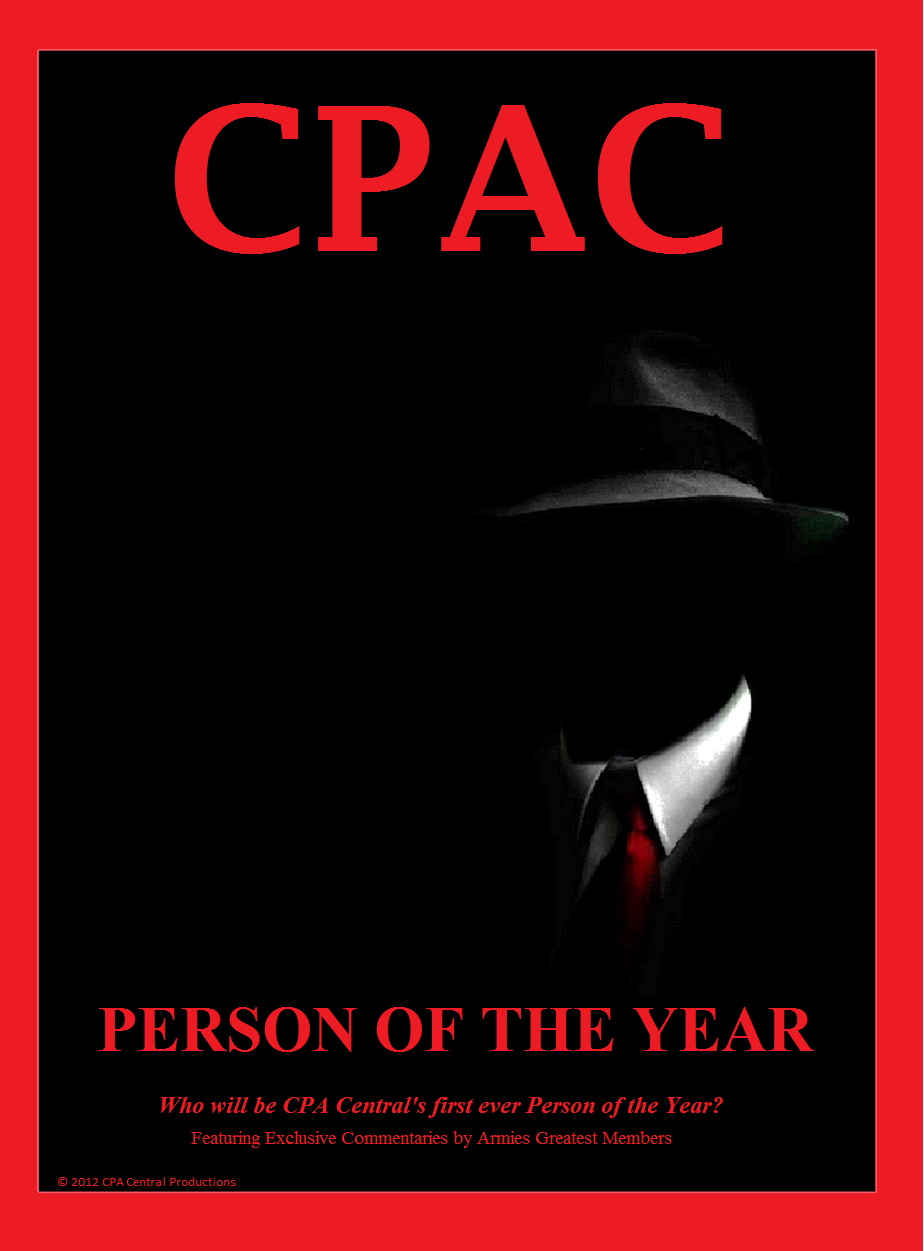
The ‘cover’ used for Club Penguin Army Central’s first Person of the Year post in 2012
It’s important to note my immediate change in language here. Throughout the entire previous section, I was very careful when writing to avoid discussing POTY as an award. Time is very clear that it should not be viewed as one, because whilst in some cases it is given in recognition of positive achievement, it is the same title given to people like Hitler and Stalin. Contrarily, the biography written by Bluesockwa2 explicitly calls POTY a win for Waterkid in the opening sentence. To further support this notion, in the foreword the following year written by Bluesockwa1, several references are made to POTY as an award. Unmistakably, POTY was introduced as an award.
We’ve talked extensively about Hitler, and the precise historical context when he was selected as Time’s POTY. Its relevance is in CPAC’s 2013 POTY post, the award’s second edition, and in this oft-referenced quote from the foreword by Bluesockwa1:
Many argue over what “Person of the Year” should mean. Should it be someone who did all or any good? I argue no. TIME Magazine named Joseph Stalin and Adolf Hitler Person of the Year. This title is something I find so intriguing because it’s something that can’t be defined. Someone could ask me, “What is Person of the Year? Is it like Most Achieved? Best Leader?”, and the reality is those are different awards for a reason.
One of the best ways to sum up what this award means to us is a collection of names constantly said. How long did that person influence the community throughout the year? What changes did they make? I stress that whether or not those changes when good is completely irrelevant what deciding the Person of the Year. So much, good and bad, has happened this year in armies. We don’t try and argue that these ten made it happen. We just argue that these ten people, for better or for worse, have been the sculptors of Club Penguin Armies this year.
This quote is referenced often and for good reason. Indeed, POTY should not solely reflect who did the best or the most good. Success is certainly a useful metric in measuring influence, but it’s not the only one.
Blue1’s mention of Hitler is somewhat misleading. Hitler is thrown in as a passing reference, and without any proper reflection or admission of the proverbial time of day in which Hitler was named POTY by Time. As previously discussed, Hitler was not named POTY with any view as to World War Two or the Holocaust, which were yet to occur. Though Hitler had surely already done horrific things, it is misrepresentative to reference Hitler’s POTY in the manner Blue1 did.
This aside, CPA Central generally kept to recognising figures who were successful and controversial. Only Flipmoo broke substantially from this pattern. He was inducted in 2014 as the only uncontroversially successful leader of the Army of Club Penguin’s ‘Triumvirate’ leadership. Starting in 2014, a second POTY was inducted each year by Small Medium Army Press. These inductions tended to favour successful community members, with less emphasis on notoriety/controversy.
As acknowledged in this post’s introduction, POTY did not survive into the CPPS Era due to the lack of a stable and unified media organisation. Curiously, neither Club Penguin Online Army League or Club Penguin Armies (2019) did POTY in 2019. There is some discussion to be had on whether a retrospective POTY would be appropriate for these wilderness years, and precedent to support separate POTYs for where the community was split in two.
POTY returned in 2020 under Club Penguin Army Hub (CPAH). It broke entirely from the CPAC format by selecting four runner-ups, and then the one winner, which was Crazzy. Crazzy was entirely inducted on the basis of her astounding success record as commander for the Rebel Penguin Federation (though Crazzy herself always co-credits Cosmo, her co-leader, for playing a major part in these victories). This said, Crazzy’s work as an architect of the Black Ice Alliance and its monopoly over the Armies community does lend a certain ‘presence’ component to her case, something we will return to later. The CPAH edition saw the introduction of trophies, which have been a staple ever since. More and more, POTY’s status was cemented as an award. A prestigious honour.

The ‘cover’ for Club Penguin Army Hub’s edition in 2020
The subsequent two years of POTY, despite being hosted by different organisations due to an unstable political landscape, were both awarded to Xing. In both years, Xing was selected in part due to his distinct ego and character, and for the controversy that inevitably followed this and his army, Templars, sending waves through the community in the process. His 2022 induction had the added benefit of a strong run as the frontrunner of the Major Armies.
In more recent discussions, I have often returned to the 2022 edition of POTY as the last ‘good’ year for POTY. It was the first hosted by Club Penguin Armies. It is true that I had direct involvement in the 2022 discussions, and this certainly colours my judgement. Still, I believe my view here is justified.
Aaronstone was a very traditional runner-up, though his case is more difficult to examine in retrospect, given his bio is largely about his OG career and his 2021 work. This was an oversight. Nevertheless, Aaron was a leader with an infamous bullish personality and a driving factor in Water Vikings’ successes during his years at the helm. Aaron possessed both moderate success and presence/character.
Spotty and Crazzy were a unique proposition, as the first-ever dual runner-ups. There is precedent for Time’s POTY to be awarded in this manner. We felt it appropriate to acknowledge their endurance, to say nothing of their contributions as individuals to the fabric of the organized community.
Legoman’s inclusion was the most unsurprising, given his perpetual notoriety and trademark persona. He fits many of the trademarks of a classic CPAC POTY, but lacked the success in comparison to Xing. If not for Xing, I suspect Lego would have been named POTY.
Finally, Superhero123’s inclusion was purely merit-based during discussions, though the influence he had is also tremendous. Super created CPA Battleground in 2022, saving the community in the wake of Club Penguin Rewritten closing and the death of Adobe Flash. Super would likely have been inducted as a CPA Legend for this, if he hadn’t received it some years prior for other CPPS work. Naming him a POTY runner-up felt like the least we could do to acknowledge his vital work.
We were proud of what we accomplished; we felt we’d selected five/six people who had significantly impacted the year’s events. The announcement was very well-received at the time. In retrospect, the only thing I personally might change is including Max as a runner-up for his work in making the unification happen. I doubt it would have gone ahead if not for Max. He may have deserved more than being an Honourable Mention. This notwithstanding, I would argue 2022’s POTY and its runner-ups hold up under scrutiny. Unfortunately, this all-round high standard started to slip in the years that followed.
The Perilous Present
To properly understand the current state of Person of the Year, it’s important to consider each year since 2022. This was a much longer process than I’d anticipated, as it involved looking back at tournament track records, Top Ten of the Year posts, and researching wars referenced in the POTY bios. It is included in full here, but if you’d rather get to the point, please jump ahead until you find the bullet-point list.
A near-completely new team congregated a year later to discuss the 2023 POTY, with only Wynn surviving from the four-person 2022 group (myself, Crazzy, Wynn, Spotty). It couldn’t have been easy to follow up 2022, a year with several strong personalities and a lot going on across the community. There was zero question as to Xing’s selection as POTY itself, and the five people recognised within the runner-ups were also very impactful. Only three runner-ups were selected for 2023, this being Wynn herself, Dino, and Legoman. The winner was Calgo, selected in the same spirit as Flipmoo before him for his successes and less so for notoriety/controversy. It is unmistakable that Calgo rebuilt the Army of Club Penguin from an S/M army on the decline back into a dominant army.
There is some drift in the extent of Calgo’s success compared to preceding winners, however. Templars’ 2022 run saw it dominate the community, and RPF’s 2020 run under Crazzy was similarly higher in its successes. Though ACP won its first Legends Cup and were the top-placing army of the year for 2023, it only won one monthly ranking and were beaten by higher weekly scores from three rival armies, their highest score for the year placing only 5th. RPF and Templars performed substantially better during their respective runs in 2020 and 2022.n Nevertheless, Calgo’s 2023 run does make for a good POTY case. Some may point to Legoman as a better candidate, and it’s true that Legoman fits the controversy angle very well. But, as I elaborate later in the post, Calgo was a better fit in my view.
The subsequent year returned to four runner-ups, with 2023 giving nods to Fitsuki for EGCP, Link3000 for RPF, Joelfreak for Secret Service/Doritos, and Mchappy for his work as CPA Admin. Ugly took the POTY title for leading ACP. A troubling element of how POTY runs becomes more visible here.
Dating back to CPA Central’s inductions, the convention for POTY bios has been that the winner is usually written by an organisation admin/ex-admin, whilst the runner-up bios may be supplied by people affiliated to the runner-up in question. In 2022, Xing’s winning bio was written by Popcorny, a Templars advisor. This became the new precedent, and it absolutely shouldn’t have. It further contributes to the glorification of those selected as POTY.
Each of the bios in 2024 has, to varying degrees, some level of bias or omission, and there are undoubtedly other examples in previous years. Ugly’s has been focused on as the chosen winner of 2024. For Ugly’s win in 2024, the bio was provided by Calgo.
Ugly’s track record is a mixed bag. ACP’s top ten record in 2024 was a notable improvement, with more first-place finishes and ACP’s best weekly score beating every 2023 score, and only being bested that year by one Doritos score. The greatest component to Ugly’s case is the Centenary Solstice War, which Ugly co-led with Roxy. Few wars in the past twenty years of CPA history have been as battle-heavy as the Centenary Solstice War, but ACP came out on top after over 100 battles.
Where Ugly’s success falls short is in tournaments. The bio, naturally, references ACP’s victory in Project Conquest: Blood Bowl (which RPF was absent from) and their losses in March Madness (losing the semi-finals) and Legends Cup (losing Round 1, and losing in Round 3 of the Loser’s Bracket) are completely omitted. Emphasis is also placed on Ugly’s presence within the Sapphire Concordat in relation to the July Jeopardy war, despite ACP not being a founding member of the original SC, and this being a one-battle conflict.
Ultimately, the bio written for Ugly by Calgo is meant to justify Ugly’s POTY, and it does its best at that. It wouldn’t be fair to place the blame on Calgo for doing his job. Nevertheless, it is a strong example of why a POTY’s bio should be written by an organisation head rather than someone affiliated with the winner.
Ugly’s case is built exclusively on his success as a leader, and unfortunately even this is very dubious. The bio doesn’t really establish how Ugly has had any meaningful influence on the year’s events, nor can Ugly (at least at this stage in his career) really be considered notorious or controversial.
It is true that 2024 was a bad year across the board for the army community. Barring the Centenary Solstice War, very little of substance occurred. But there was one shining light amongst the wider problems facing the community: the first edition of Around the World Cup. Around the World Cup has grown more and more popular over the years, featuring a round-robin format and the twist that the time zone would change for each battle. It was voted the Best Modern Tournament during the CPA20 celebrations earlier in the year, with some even suggesting that it ought to replace March Madness as the Spring tournament next year.
Around the World Cup was created by Mchappy. It is the crowning jewel of Mchappy’s legacy as a CPA Admin, and its continuing popularity is a testament to how much more Mchappy could have done if he hadn’t been so constrained by needing to maintain a very unsteady ship. Mchappy is, in my view, the true Person of the Year for 2024. It’s not unreasonable to suggest CPA may not have survived 2024 without his influence.
The most recent Person of the Year (2025) returned to just three runner-ups. These were BestPenguin (Aliens), Daniel20448 (ACP), and Logical (Void Troops). Link3000 took the victory after another year leading RPF. Link’s victory was largely success-based. RPF was 1st on the Top Ten Armies of the Year, including a staggering 28 weeks at the top and an 11-week streak at the end of the year. This significantly surpassed ACP under Calgo and Ugly in the previous two years. Link also had the benefit of a substantially better tournament track record, sweeping the Big 3 classic tournaments.
The bio for Link was written by Dino instead of someone currently in RPF, though there is still a glaring issue with Link’s case as presented by the bio. It would be unusual to present Link with POTY without referencing the Beanie Babies scandal, but Dino’s presentation of events is somewhat misleading.
Much of the public communication from RPF throughout the scandal either came from Gabgeirl, and behind the scenes, a lot was handled by Twitchy543. Whilst it is certainly true that The White Order alliance declared war on RPF, and that RPF won this conflict under Link, the overwhelming community criticism of TWO ultimately swallowed up the in-game warfare. It would be more correct to include Ugly as a runner-up for 2025 due to his presence within TWO. Alternatively, there’s Edu14463/Jojo Teri, whose handling of the scandal via CPA drew praise and scrutiny. Miffy and Ellie, who sat at the heart of the scandal, have more relevance to the Beanie Babies scandal than Link.
Someone more closely related to the scandal (and there were seven people to choose from for this) could have been included as a runner-up instead of falsely attributing anything about it to Link as a person. It’s especially frustrating that this didn’t happen given there was room for a fourth runner-up. Of the seven names above, Ugly probably stands out the most in view of his other work in 2025.
Again, it’s important to note that Dino was only doing his job in trying to write a bio that justified the selection of Link. Still, the problems with the bio demonstrate how Link’s case solely rests on their successes. Whilst Link’s track record is a substantial improvement on Ugly and arguably surpasses Calgo, the overarching issue is unmistakable at this point.
POTY has become too much about success on its own.
Before we continue, here is a summary of what that entire section just covered about each year:
- Calgo received POTY in 2023 largely on the back of his successes. His track record was notably weaker than Xing’s the previous year. That said, ACP did win its first-ever Legends Cup under Calgo. It’s unmistakable that Calgo had some level of voice and presence during his tenure. This element is especially important to justifying his case.
- Ugly’s POTY in 2024 was similarly success-based, but with a much more mixed track record. Though ACP performed better on the Top Ten, it didn’t so much as reach the finals of March Madness or Legends Cup under Ugly. Given Ugly was also a reasonably uncontroversial leader, it’s strange that Ugly was recognised over a figure like Mchappy, who essentially held Club Penguin Armies, as an organised community, together throughout 2024. Mchappy’s creation, Around the World Cup, emerged as the most popular tournament concept of the CPPS Era.
- Also worth noting is the trend of POTY winners having their bios written by people affiliated with them, rather than by org heads as was the case in OG. Though this trend was present as early as Xing in 2022, the dangers of it are best pronounced in Ugly’s bio by Calgo.
- Link3000’s POTY in 2025 is yet again success-based. Link’s track record is significantly better than Calgo’s or Ugly’s, and in some places even surpasses Xing. Link’s bio was written by someone from CPA. It still has issues, containing a ‘controversy’ angle that doesn’t really reflect the facts. It could also be argued that more controversial options were overlooked in favour of a ‘safe’ option.
There is a common denominator and a noticeable trend across these three inductions. Firstly, all three bios place an emphasis on the inductee’s success. Secondly, this emphasis grows in prominence over the years. Though Link’s winning case in 2025 features a ‘controversy’ element, its validity really doesn’t hold up. So, in reality, all three cases rely heavily on the POTY’s assumed success.
This is not what Person of the Year is meant to be. Success has become too heavily weighted as the deciding factor, when it should only serve as one of many measurements.
So what is Person of the Year meant to be? What function does it serve? Where do we go from here?
Remarks in Review
Before continuing, I’d like to briefly overview some of the observations and arguments I’ve made across the previous three sections:
- The original POTY, created by Time Magazine nearly a century ago, was always intended to measure a person’s influence on the world, whether this be positive or negative.
- When introduced into CPA, POTY was created by CPAC as an award. This was a mistake for several reasons.
- In some instances, bios for POTY winners are written by people affiliated with the winner. This is not a good practice, as it predisposes a bio to focus on a winner’s successes and positives.
- POTY’s status as a prestigious award has gradually shifted its focus away from overall influence and narrowed its focus to a candidate’s successes alone. The POTYs of 2023-2025 depict this shift.
- POTY’s status as a prestigious award inherently discourages the selection of controversial figures. This compromises the intended function of POTY. This is not a point I’ve made previously.
Person of the Year is about a person’s influence, not their success. Success is only meant to serve as a means of measuring influence. Discussion of a person’s notoriety serves the same purpose.
The trouble is that this notoriety is not always from something as benign as a multilogging scandal, or troopstealing. Some of the most influential figures in our community’s history had that influence by doing terrible things. We could not discuss 2017/2018 without discussing Security. Club Penguin Online and the resulting scandal have their origins in Waterkid, or Riley as he was known then. And what about him? How do we even begin to discuss him? Can we? Should we?
These are, of course, more extreme examples. Nevertheless, Person of the Year is not given as an award by Time precisely because of this problem. How can the most influential person be recognised if conferring POTY on them glorifies them, thus discouraging more controversial selections? We don’t want to glorify or reward bad or dubious behaviour, after all. So, we’re left with a choice. Person of the Year could continue to exist as an award, but this would mean it losing its integrity as a marker of who truly had the most influence on the community within the given year. Alternatively, we can choose to move away from discussing it like an award. We can make an effort to start looking at it again for what it was meant to be.
Before closing off this OpEd, I’d like to offer three final things.
Firstly, I believe that any good POTY possesses a trait separate from how successful/notorious they are: presence/character. I referenced this briefly when discussing Calgo earlier. In my view, what makes Calgo the top candidate for 2023’s Person of the Year is not his success, but that Calgo consistently demonstrated a voice and active engagement with the community of the day. He had presence. A clear character. I feel this component is crucial, and that a nominee without it should not be Person of the Year, no matter how successful they are.
There is the lingering question of precisely how success and notoriety should weigh against each other. At what point does notoriety outrank success? What should the new balance be? This is the main issue I present for the POTY committee this year, and I would caution them away from blindly prioritising success. It is likely that this debate will play out in real time this year between Sidie9, whose rule as Templars Empress has faced much controversy and caused mayhem at every turn, and Daniel20448, a highly successful ACP leader and emerging voice on the global stage.
Secondly, on a more personal note, I’d like to briefly thank everyone I spoke to whilst working on this post. Particularly, I would like to thank Eden, whose frustrated musings on POTY’s intended status as a non-award prompted me to dig into how CPAC presented POTY as an award from the start. I would also like to acknowledge Jojo Teri’s moral support and answer a question he posed in response to my explanation of this post:
‘If POTY isn’t meant to be an award and we should stop treating it as one, should we stop giving out trophies for it? Discontinue the practice of titling?’
To answer this question, I would like to offer the story of Hitler’s POTY, and how Time magazine handled the occasion.
Though no one could predict what was to come, one publisher at Time recognised the evil Hitler represented, and felt this needed to be reflected in the issue’s cover. Every previous POTY had been featured on the front cover with a traditional portrait. Instead of this, Ralph Ingersoll successfully pushed for the use of a piece of artwork by Rudolph Von Ripper, an Austrian-born painter who had been imprisoned in the Early Camps of 1933-34. The artwork was a lithograph of a Catherine wheel, depicted atop an organ with naked bodies hanging from it. Hitler is depicted playing the organ. The artwork’s title was included as a caption on the cover:
‘From the unholy organist, a hymn of hate.’
Hitler was named the 1938 POTY, and no one could possibly have mistaken this for an endorsement of his actions. I’m sure similar alternatives to a trophy could be considered if it were necessary.
If you made it through this entire post, I thank you for your time. I hope this post supports a change in how POTY is viewed. I really hope it encourages the people who make the decisions on POTY to reconsider how it’s handled going forward. As is so often the case here in Club Penguin Armies, things need to change.
Rowan Alden
Opinion-Editorials Contributor
More to follow.