
The community has an underlooked history of jesters. Today, I examine the implications of what troll armies have meant and can do for our community.

Designed by Master DS
WARNING: Many of the troll armies discussed in this opinion article contain depictions of offensive material, including antisemitic and sexist material. Due to the sensitive nature of this imagery, a warning has been given regarding this content.
TO DO A LITTLE TROLLING
Troll armies have existed for as long as there has been an army community to troll. These armies do not come in one shape or size. They do not come around in the same context, time, or purpose. Oftentimes, the troll army itself is a time-sensitive, context-sensitive decision and may have its purpose lost to time. Some troll armies have succeeded in infamy, such as the Purple Republic, which terrorized the community with botting and event disruption. Others remained flash-in-the-pan moments of controversy, such as the PG Family Friendly Disney-Initiated Cuddle Kittens. CK lived as an army that pushed the envelope with inappropriate tactics so far that the army was banned in three days. More recently, we’ve seen another uptick in troll armies: the Boxmen of Boxland revival, the Cult of Tung, and the Restricted Very Violent Disney Abolished Snuggle Cats, a spinoff of CK. This is not an accident.
What I would like to argue is that troll armies come about as an argument against the community. While some troll armies exist simply to make light of the community in an unoffensive, unobtrusive way, a large pattern can form when we look at the history of troll armies as a whole. What brought the Purple Republic to engage in all-out botting warfare organized on the boards of 4chan? What was so important about the Social Justice Army‘s claims falling on deaf ears? Troll armies are inherently statement armies. We should consider their actions as not just silly decisions made to mess with people, but instead an underlying question of whether or not the institutional systems that allow them to pervade are themselves effective. This analysis will focus on four distinct cases: the 2011/12 and 2014 Purple Republic, the 2017 Social Justice Army, the 2019 Cuddle Kittens, and the more recent 2026 Boxmen of Boxland.
The Purple Menace
Purple Republic
In 2011, the Purple Republic was founded within a Steam group page by an individual known as Violantealleta, as an antithesis army to the entire community. Instead of using the popular Xat platform, they used Steam community chat. The army would frequently provoke and raid other armies in an effort to drive them away. This army had become notorious for its messaging and overall impact on the community’s decision-making. The army would be known for botting, inappropriate tactics, and overall tendencies towards being a nuisance to the community. Their trolling had resulted in the creation of the Pink Alliance in July 2011, an omni-alliance of virtually the entire community against this singular threat. However, as the recognition of the army as “trolls” became more understood, the community’s interest dwindled. Then there was “Zero Day“.
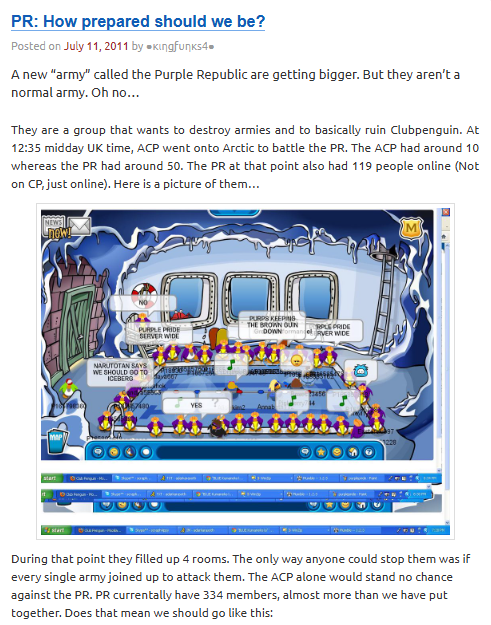
Kingfunks4 addresses concerns of a Max 119 army, the Purple Republic, on CPAC. Their size was an indicator of potential botting concerns.
Zero Day was a theoretical final attack on the community with the effort to end Club Penguin armies once and for all. During this time, an individual known as Bluesockwa1 would begin reporting for Club Penguin Army Central, with a particular emphasis on the Purple Republic. This began a controversial and adversarial relationship between CPAC, which would later be run by Blue1 (and Bluesockwa2). However, this theoretical “Zero Day” came and went, and nothing came of it. The army would return in 2012, when it would continue its usual offensive tactics and raid efforts. Ever since, the army would remain one of the most infamous and pestering forces in the community. Later — and much smaller — efforts would be made, with their eventual recognition by Blue1 as an army in their 2014 iteration largely taking a significant amount of the bite of their efforts.
It would be surprising to think about a troll army being regarded as one of the most influential armies of all time, especially in the modern era, wherein this sort of trolling effort simply does not have the vice grip it used to on the community. However, the Purple Republic did in fact have such a degree of influence, particularly in response to its botting efforts, that the entire community did have to band together at one point to handle it, with significant fears that in the future it may have to do so again. At this time, the community was forced to figure out the botting issue. How does a community even deal with something like this? Events were raided and attacked, all in the effort to specifically take out the community that it participated in.
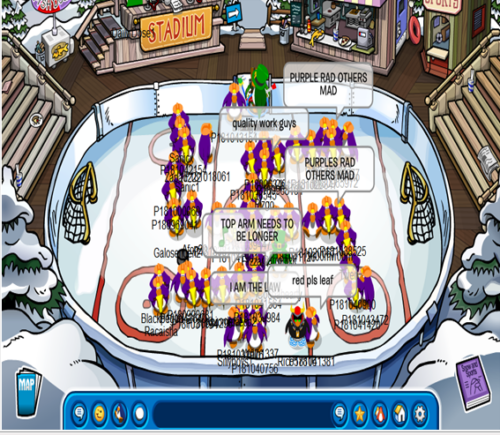
The Purple Republic’s infamous “Swastiget” formation.
Eventually, the answer was rather tacit: play by our rules or get ignored. The community largely realized that this army only fed on shock value, and had no lasting interest in the community beyond perhaps some spiteful individuals who chose to take on its name. Yet, for a time, and for years after, no other army would have singularly affected the perception (and the expectation) of troll armies, the community’s response to it, and the overall power of a single force that could terrorize a community. The lesson we learned from the Purple Republic, and one that has been held by the community ever since, was that troll armies simply exist as part of our ecosystem and need to be recognized to some extent.
Fighting a troll army is a fight in vain. The troll army presumably does not care about the structure of wins or losses (like the Purple Republic does), nor does it care about the structure of decorum (as shown by their insistence on the “swastiget” formation, essentially a swastika with penguins using the hard hat drilling emote), and fighting it on those grounds was ultimately in vain. The historical argument I would make is that “Zero Day” succeeded in its functional goals, to make the entire community so meaningfully afraid of existential threat that it did, for a moment, believe it could have lost everything. It didn’t matter that the Purple Republic never logged on for Zero Day; it mattered that the community logged on.
This threat was dealt with by Bluesockwa1 allowing the PR to be on the Top Ten. Suddenly, the PR was not some outside force, but rather just another army like any other. Its 2014 iterations onward would simply never have the power to forge an omni-alliance like the Pink Alliance. This is because the extent to which the community could be trolled now existed entirely under the control of its own domain, not as an outside force, but as one that implicitly agreed to play ball with the rules set forth by its community. The lesson we take from the Purple Republic is that troll armies can be controlled and accounted for within the systems of power that we create. They are playing our penguin game. They are playing by our rules.
An Unspoken Jester
Social Justice Army
To this extent, the community has since taken troll armies to be a sort of “court jester.” The troll army now serves a harmonious role within the organization structure. It acts as a way now to provide limited, targeted criticism. I believe there is no other army that succeeded quite like this than the 2017 Social Justice Army. The SJA was a small, mysterious little troll army that lasted for a month and satirized the “Social Justice Warrior” archetype. However, it would make a declaration and accusation unusually accurate, with leaks unusually accessible to its leader.
To this day, the exact identity of Khayratt Quran is rather unknown. For us who were around for it, the army stood as little more than something to scoff at and make fun of. They asserted control of the entirety of CPPS.me’s servers began a war with the Underground Mafias Army led by Dillon under the assertion that the army was run by “Nazis,” and subsequently lost that war, disappearing into nothingness afterwards. Supposedly, I myself had been a part of this army under a pseudonym I used, but just to show how ineffective the overall legacy of this army was, I hardly remember it. Then, there was a post.
The army leader had gained access to screenshots claiming that Elmikey, the Rebel Commander at the time, knew that their fast-rising high command leader Left was actually XxToysoldier, a controversial figure from armies’ past. To claim that the Rebel Penguin Federation was housing such a controversial leader (the former leader of the Dark Warriors who performed an illegal rebrand and was ousted from their ranks) would have been an absolute firestorm in the armies community at the time. However, screenshots could always be faked. The words came from the mouth of a jester. The claim was largely considered, as preposterous as it was, not particularly important to talk about. Except, Khayratt’s army was completely correct.
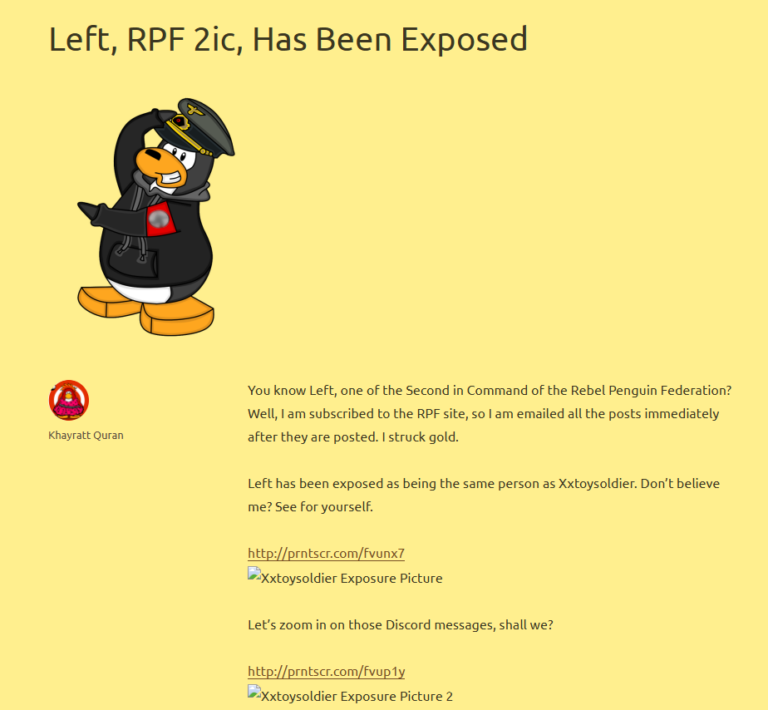
Left is XxToysolider, as revealed by Khayratt Quran.
Khayratt’s post would be made in July, months before Elmikey himself would reveal the information to the public, confirming the rumor discussed so long ago. After Elmikey was couped from the RPF, he revealed that the information that Khayratt Quran ultimately had was, in fact, real, and that XxToysoldier and Left were the same person. This led to Left’s brief retirement from the RPF right as Elmikey began the Rebel Penguin Marines. This was an explosive course of action that happened around this piece of information that was buried behind a poorly-documented troll army at the time. The jester spoke, but their words fell on deaf ears. What would the community have done if it took the posts seriously? What would happen if Elmikey was direct about that fact in July, in lieu of the growing tensions around his leadership? There was a timeline being built, but cut short, because the jester was not listened to.
The Social Justice Army’s legacy should hardly be understood as one of natural, normal success, even for the standards of a troll army. The army’s leader was clearly an alternate account, an individual within the tight-knit and tiny community around Club Penguin Rewritten armies, who had a working relationship within the Rebel Penguin Federation – or at least Elmikey. That individual decided to leak information under the guise of a troll army, and the nature of doing so through a troll army ultimately led to its information being disregarded. At the time, the army was seen as a fool with no point, fabrications with no aims, and ultimately information with no use.
AN OUTSPOKEN JESTER
PG Family-Friendly Disney Initiated Cuddle Kittens
This section, for better or for worse, will be written from the perspective of one of its founders: myself. The community in 2019 remains one of the few immortalized times of a league’s success, with statesman DMT at the helm, the growing shift of our community towards the use of Club Penguin Armies: The Game, an in-house CPPS run by Superhero123, and the Rebel Penguin Federation‘s decision to focus on a more generalized community producing their Strike Force. The War of Smoke and Sour was the primary discussion of the time, between the Lime Green Army and the Recon Federation of Club Penguin. It was in this time that we would do a little trolling.
The RPF’s Rebel Commander at the time was Queenieliz, someone whose legacy is remembered with the singular word “annoying” above all else. While the Cuddle Kittens ultimately formed out of Cena‘s desire to revive another army with a significantly more NSFW name, the army quickly became a satirical jab at the league more than anything else. Virtually all efforts, in retrospect, were really mostly to get on the league’s nerves, with the RPF being a convenient target for army warfare-based harassment. The name itself was a tongue-in-cheek response to the original troll army’s barring from registering, by taking an aggressively-long, overly hammed-up name that still was NSFW in the end (using the acronym version of the full name). The army would then be required to be known primarily as “Cuddle Kittens” by the league. The army would schedule a flurry of invasions against the RPF. The league would then require a hard cap on the number of invasions that can be scheduled. The army would be, realistically, max two, maybe three. The league then required an invasion minimum of 5 to be regarded as valid.
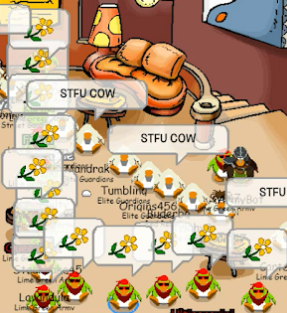
One of the Cuddle Kittens’ “cow” tactics that produced a 24-48 hour ban on CPATG for its participants.
Then, the infamous tactics, deemed sexist (rightfully so, in retrospect), would get the army banned from the league three days after its opening. The army had managed to create a firestorm so significantly impactful that its outspoken nature was shut down in 3 days. It saw, at most, two scheduled invasions that would go through. The army, if it ever cropped up, had its ban upheld by multiple organizations for one reason or another, including in Club Penguin Armies, most recently in August. Its legacy can be felt by contemporary veterans who remember the whole ordeal as a massive headache, and a reminder of the necessity of putting up safeguards against troll armies.
What did we meaningfully learn from the outspoken jester? For many people, even its contemporaries, the answer would probably be “nothing of major importance.” However, the status of this army as the black sheep of the community cannot be understated. The troll army managed to cross so many lines so quickly that a silent, functional agreement to remove the army from its position as a legitimate army has been maintained now for over 7 years. The Purple Republic was integrated, while the Social Justice Army was ignored. Comparatively, the Cuddle Kittens were so unignorable from an integrated position that they now stand as an example of when a troll army should be ousted, when its purpose exists to define bannable offenses.
My understanding of the legacy of the Cuddle Kittens is a lot more sympathetic towards what it inadvertently accomplished as opposed to what it was banned for. Ironically, I myself was never present for the infamous “cow” tactic, but my own name is still attached to it. I willingly hold the army as a part of my history. To act like the army’s initial goals were anything but harassment and more-or-less blind criticism would be asinine, but it did accomplish these things. 2019 CPA put into place rules that we now take for granted as part of logical decorum in armies. A troll army that produced positive change, even if at the expense of said army, is an accomplished one.
THE JESTER WE LISTENED TO
Boxmen of Boxland
Where all other troll armies have failed in some respect to maintain their change with a positive impact on the army, the Boxmen of Boxland have succeeded. We know the army for their frequent invasions of Tuxedo, but more importantly, from a recent case in which their leadership structure tested the waters for Club Penguin Army Judges. Simply put, the Boxmen of Boxland humorously decided to have an egregious number of leaders. This results in an administrative difficulty for organizations that often categorize these leaders and give them private channels to discuss aspects of the game. Notably, due to so many people requesting Boxmen of Boxland leadership, this exposed an apathy within the Club Penguin Army Judges leadership and added more straw to an already-broken camel’s back.
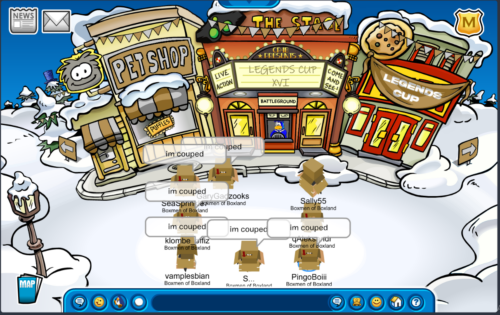
The Boxmen of Boxland making, well, a box.
I don’t think it’s particularly suspicious that a troll army exuding some sort of administrative burden coincides with a change in that structure. The army was mentioned as part of the open letter produced by the Army Judging Board founders, and would not have been mentioned if it failed to be impactful. These sorts of burden tests still exist in our community. For the troll army, and for those who do not believe that troll armies have anything to say, the Boxmen of Boxland simply accomplished something funny. For me, however, the army succeeded at making the community ponder another failure. As time goes on, I would hope that the troll army would be given its flowers in respect to what it has managed to accomplish.
TO BECOME THE JESTER
The impact of a troll army is inherently small. The meaningful, radical change of a troll army may not come within the troll army’s purview itself, but neither can the jester inherently do so. I describe the relationship of a troll army to its league like a jester to their king for this exact reason. The court jester is a way to reveal flaws, insecurities, or failures of the king without hurting the king’s ego. A jester is a political force of opposition, a minority leader, who may inspire change through their actions in a more subtle way. The accomplishments of all stated troll armies could easily have been understood to be the unanimous correct decisions of their administrators. Bluesockwa1 could have been understood to have “solved” the Purple Republic, Elmikey being the serious voice of revealing Toysoldier’s hidden identity in the community, DMT and Greeny having “dealt with” the Cuddle Kittens, and Cobra and Pjayo having indicated the problem with CPAJ. However, if it were not for the two-way street, the jesters to these kings, would these have been meaningful, impactful decisions? Would they have made these decisions in the first place?
It is in this sense that administrators have troll armies to thank for a small degree of their success. Just as the court jester highlights the backstabber amongst the king’s advisors, or cools tensions within the war room, the troll army highlights the need for new administrative policy, discontent with organizational failings, or sets precedent for how to engage with troll armies altogether. I urge the community to listen to its jesters, because at times, they may prove to have something to say. For those running troll armies, I urge you to consider saying something. You might just walk away with a positive advancement for the community.
Overall, troll armies’ contentiousness may prove to create controversy, but their history is one of changes to the community. If nothing else, the community’s history is itself the history of troll armies. Where there is a future for the community, there is a future for the community’s jesters to encourage change.
Rosaferri
Reporter