
The Club Penguin army meta has grown increasingly stagnant, with few innovations despite the community having its own CPPS to experiment on. It is overdue to shake up that meta and truly leverage the creative potential of running our own server. With that in mind, this post explores what Club Penguin army warfare might look like as a video game, specifically a Multiplayer Online Battle Arena.

Designed by Master DS
INTRODUCTION
For those unfamiliar, a Multiplayer Online Battle Arena, or MOBA for short, is a type of game where two or more teams face off on a shared map, each player controlling a single character. The matches usually involve moving through zones, fighting enemy players, and controlling strategic areas or objectives to gain advantages and ultimately secure victory. Success comes from a mix of quick reflexes, smart positioning, and teamwork, with each player contributing in a way that complements the rest of their team. Popular examples include Smite, Dota, League of Legends, and Deadlock.
For this thought experiment, the focus will be on a game I’m calling Penguin Arena. To start, I want to establish a clear set of parameters that will guide its design. While many games echo certain aspects of Club Penguin armies, my aim is not to simply repackage these games. Instead, I want Penguin Arena to capture the unique spirit and charm of Club Penguin armies. So, by setting clear boundaries from the start, I can explore how to translate these elements into a MOBA without losing what makes Club Penguin armies so special.
Parameters:
- Setting and identity are preserved: Players control penguins battling across an arctic island.
- Strength in numbers: The number of players on a team directly shapes strategy and outcomes.
- Team coordination is essential: Effective communication and cooperation drive success.
- Room capture is central: Gameplay revolves around capturing rooms, keeping the core Club Penguin army mechanic at its heart.
- Emotes and formations are meaningful: These are incentivized as strategic tools rather than purely cosmetic flair.
- Snowball combat is integral: Throwing snowballs is a common, everyday part of gameplay.
Let’s begin!
CLASSES
All penguins will be able to throw snowballs as part of combat, and each penguin will belong to one of three classes that shape how they contribute to their army. These classes can be called: Warrior, Guardian, and Cleric. Together they reflect the familiar tank, healer, and attacker roles seen across many video games, giving armies clear ways to balance offense, protection, and support. If a penguin loses all their health, they will be forced into Spectator Mode for two minutes, after which they will respawn.
Warrior
Warriors are the bold, forward-driving members of the army, designed to dish out as much damage as possible. They excel at breaking through enemy lines and pressuring opponents with fast and deadly snowball throws, but their lower health means they need to stay aware and rely on teammates for protection. Each snowball they throw has a short cooldown of two seconds, letting them maintain a steady offensive presence while the battle unfolds.
Guardian
Guardians stand at the front, absorbing the brunt of enemy attacks and protecting their teammates. Their high health makes them tough to take down, and their signature ability, Snowball Magnet, pulls nearby snowballs toward them for thirty seconds, allowing the army to push forward while minimizing harm to more fragile allies. This powerful ability can only be used once every ten minutes, and their snowballs have a slightly longer cooldown of four seconds, encouraging careful timing and strategic placement.
Guardians also have an ability called Fortify, which lets them build defensive walls around rooms after an army has captured them by placing individual wall units. Each placement has a thirty-second cooldown, so fully encircling a room requires multiple Guardians working together. These walls have their own health bars and can be damaged or destroyed by enemy attacks.
Cleric
Clerics offer a versatile role, supporting the army through both healing and combat. They can throw snowballs at enemies to deal damage or aim them at allies to restore health, giving them a flexible impact on the flow of battle. With high health and a six-second snowball cooldown, Clerics are able to stay engaged in the fight while providing crucial support, turning the tide in moments when the army is under pressure.
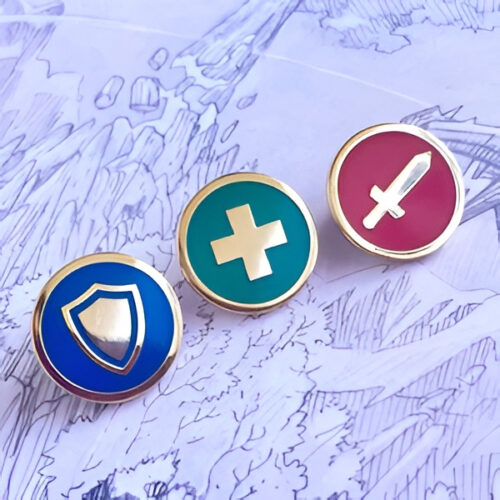
Standard MOBA class icons for Tank, Healer, and Attacker
GAME MODES
Every strong MOBA lives or dies by the variety and depth of its game modes. These modes define how players compete, shaping everything from strategy and teamwork to pacing and replayability. Below are several game mode ideas designed to capture the spirit of Club Penguin armies. Army leaders can also create custom lobbies where they choose the game mode, select an opposing army to challenge, and schedule the battle for a specific time. Once a challenge is issued, the opposing army is notified automatically, and the match is locked in. However, matches must be scheduled at least 24 hours in advance to give both sides time to prepare.
Room Gauntlet
This is a best-of-three mode where armies fight across three different rooms, each acting as its own round. Every round lasts 10 minutes, and the goal is to push a single shared Capture Meter in your army’s favor by maintaining control of the room. At the end of the timer, whichever side has pushed the meter farther wins that room, even if the zone was never fully captured. At the end of each round, the armies are automatically teleported to the next room. Whichever army wins the majority of rooms is declared the overall victor of the battle. This game mode intentionally mirrors the classic three-room battle format used in Club Penguin armies today, bringing that familiar flow into a more system-driven setting.
Presence-based capture works as the engine behind how the Capture Meter moves during each room. Every player standing inside the room actively pushes the meter in their army’s favor, and those contributions stack. A single player might generate +1 capture power per second, so if 10 players are uncontested in the room, the meter moves at +10 per second. When both armies are present, their influence directly cancels out. For example, if one army has 20 players in the room and the other has 19, the net movement becomes +1 per second toward the stronger side. If both armies have equal numbers, such as 15 vs 15, the meter stalls at 0 movement, creating a tense standoff where neither army gains ground until something breaks the stalemate.
That balance can change quickly through combat. Taking damage reduces how much a player contributes, so a healthy player might provide +1 per second, while a damaged one might drop to +0.5, making them easier to outweigh even if numbers are equal. If a player is knocked out, their contribution becomes 0 until they respawn. In a 20 vs 20 standoff, the meter might remain frozen, but if one player gets eliminated, it becomes 20 vs 19, and the meter immediately begins moving at +1 per second for the stronger side. This makes every snowball hit meaningful, since every hit directly impacts capture speed by weakening the opposing army’s ability to maintain presence in the room.
Island Conquest
This is a long-form territorial struggle in which armies compete to dominate the entire island by taking control of every room on the map. It uses the same presence-based capture system as Room Gauntlet. Fast-travel via the map is disabled, so players have to physically move between rooms, though a few exceptions remain: a path from the Mine Shack leads to the Dojo Courtyard, and a boat from the Cove allows access to the Iceberg. A match concludes immediately if one army succeeds in claiming all rooms, but it can also run for up to 24 hours from its creation, continuing even when nobody is actively online.
If the time limit is reached without full conquest, victory is awarded to the army controlling the greatest number of rooms, while an even split results in a draw. This format places strong emphasis on sustained coordination over time, and defensive tools matter significantly; the Guardian’s Fortify ability becomes especially impactful for holding key rooms and slowing enemy advances, often determining whether a front line holds long enough to swing control of the island.
This game mode could be made even more interesting if we added a simple resource system. Each player has a Hunger Meter that slowly goes down over time, and once it drops below half, their health starts to drain as well. Every army can also select a room to serve as their base where food can be grown. O’ Berries will randomly spawn across all rooms, and players can collect them into their inventory. From there, they have a choice: eat them right away to restore hunger, or bring them back to their base and plant them so they grow into more O’ Berries for later use.
To add an extra layer of tension, armies could also steal food from each other. O’ Berries stored at a base can be raided during battles, and players who are defeated drop the supplies they’re carrying, allowing others to pick them up. This forces armies to juggle territorial pressure with sustenance, as maintaining a steady food supply over a 24-hour match becomes essential, and targeting an enemy’s food supply can be just as effective as taking their rooms.
King of the Iceberg
This game mode forces both armies to fight over control of a single room for the entire 30 minutes. The army that holds control of the room for the greatest percentage of that time is declared the winner. By default, matches take place at the Iceberg, though the lobby settings allow this to be changed to any other room. Control is handled through the same presence-based capture system used in Room Gauntlet.
Snowball Skirmish
This is a game mode built around constant fighting, where armies face off with the goal of eliminating opponents using snowballs, with no room capture objectives. Armies can move freely across the map as organized teams, and clashes break out naturally whenever they encounter each other, keeping the action going almost nonstop. Fast-travel via the map is disabled. Every successful elimination increases the army’s total score, and after 30 minutes, the army that caused the most eliminations is declared the winner.
Anarchy
This game mode is a fast-paced free-for-all where everyone enters as a Warrior and fights only with snowballs until one player is left standing. There are no teams and no rooms to capture, just pure individual combat from start to finish. Snowballs can be thrown quickly, with a lowered one-second cooldown. Fast-travel via the map is disabled. As the match goes on, an avalanche gradually spreads through the map, filling rooms with snow and cutting off access to them, steadily shrinking the playable space until everyone is forced into closer and more intense encounters. The last surviving player wins. Army leaders can use Anarchy as a fun event format for their troops, offering a lighter, more chaotic alternative to structured battles.
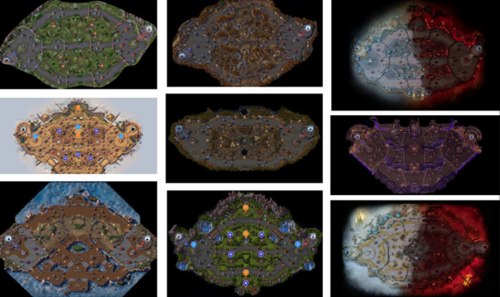
9 of the 16 maps in the MOBA game Heroes of the Storm
EMOTES AND FORMATIONS
Up to this point, we’ve explored the mechanics that shape the battlefield. This next and final system focuses on the players themselves and their ability to work together. Formations and emotes allow armies to convert discipline and coordination into battlefield advantages that can alter the course of a match.
Army leaders have access to a dedicated command interface containing a curated set of emotes and formations available to their army. From this menu, a leader may issue a command, which is instantly broadcast to all allied players. Upon receiving the order, players are given a brief execution window during which they must either perform the specified emote or assemble into the designated formation.
Successfully executing a command grants an army-wide passive status effect whose strength scales with the quality of coordination achieved. Each command receives a performance rating based on participation, speed, and accuracy. Partial or delayed compliance results in weaker effects, while rapid and widespread synchronization yields stronger bonuses that can significantly shift momentum on the battlefield.
Emotes
When an army successfully executes an emote command, all members gain a temporary boost for a few seconds. The following examples illustrate the kinds of bonuses emotes can provide:
- E6: Increases the army’s snowball damage and healing.
- E9: Increases the critical chance of allied attacks and heals, making them more likely to deal or restore double their normal amount.
- EH: Restores a small amount of health to all allied players.
- EU: Reduces ability cooldowns for all allied players.
- E4: Reduces the critical hit chance of the opposing army.
- EP: Reduces damage taken by all allied players.
- EM: Grants the army bonus resource generation from captured rooms.
- EK: Allows snowballs to pass through an enemy or ally and affect one more adjacent target.
Formations
Unlike emote bonuses, the bonuses from formations remain active as long as enough players maintain the required positioning. The following examples illustrate the kinds of bonuses formations can provide:
- Triangle Formation: Increases the army’s snowball damage and healing.
- Pyramid Formation: Increases the critical chance of allied attacks and heals, making them more likely to deal or restore double their normal amount.
- Circle Formation: Increases damage dealt to enemies within the formation’s perimeter.
- Plus Formation: Provides passive health regeneration to all allied players.
- H Formation: Increases the maximum health of all allied players.
- T Formation: Reduces damage taken by all allied players.
- V Formation: Reduces the critical hit chance of the opposing army.
- L Formation: Reduces ability cooldowns for all allied players.
- M Formation: Grants the army bonus resource generation from captured rooms.
- W Formation: Increases the duration and effectiveness of the army’s emote bonuses.
- X Formation: Allows snowballs to pass through an enemy or ally and affect one more adjacent target.
Whew, after all that, I’m glad to finally have this put together. What started as a hypothetical question about what army battles might look like as a video game turned into hours of thinking through all the little details that would actually make it work. I guess all that time I spent messing around with GameStar Mechanic as a kid finally paid off.
I hope this post demonstrates just how much creative potential there still is in the army community. We’ve spent years refining the same formulas, but with more creative freedom than ever before, there’s no reason we should be content with continuing to repeat what has already been done. The future of army warfare is ours to create, so it’s time to build something the community has never seen before.
Ulysses Nardo
Opinion-Editorial Writer