Twenty years ago, a group of players gathered on Club Penguin and imagined something that, at the time, could hardly have seemed destined to last. And this was how armies were born.
What began with colored teams, snowball fights, and rival clans would become something far greater: a community with its own leaders, traditions, wars, alliances, media organizations, culture, tournaments, institutions, friendships, rivalries, triumphs, failures, and history. Tomorrow, on September 29, 2026, the Club Penguin Army community celebrates its 20th anniversary.
Twenty years is an extraordinary amount of time for an online community. It represents generations of people who came and went, platforms that disappeared, armies that rose and fell, and countless hours spent building something that existed because people cared enough to keep it alive. This anniversary belongs to all of them, wherever they are right now.
BRIEF HISTORY OF OUR COMMUNITY
The story of the Club Penguin Army community begins in 2006. Before there were sophisticated army websites, Discord servers, judging organizations, elaborate tournament systems, or established organizations, there were simply players meeting on Club Penguin and organizing themselves into competing groups. The earliest Color Wars gave way to something new. On September 29, 2006, Oagalthorp founded the Army of Club Penguin, establishing a model that would profoundly influence everything that followed: a defined army, leadership, ranks, uniforms, a home server. Others soon followed. The Underground Mafias Army, the Romans, the Nachos, the Rebel Penguin Federation, the Ice Warriors, the Dark Warriors, the Watex Warriors, and countless others would emerge across the years. What had begun as groups of players became a genuine community.
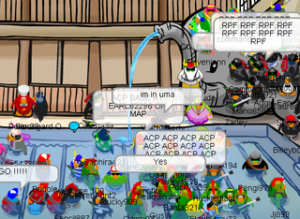
Wars became larger, leadership became more sophisticated, and armies developed their own identities. And, perhaps most importantly, people began to understand that they were participating in something larger than any individual army: the army community had been born.
The late 2000s transformed Club Penguin warfare from simple gatherings into an organized competitive culture. The Miniclip forums gave way to WordPress sites. Xat became the meeting place where generations of soldiers spent countless hours talking, recruiting, planning, arguing, laughing, and preparing for battle. Websites became headquarters. Uniforms became symbols of identity. Alliances became political institutions. The World Wars, the rivalries between major powers, the rise and fall of armies, and the enormous battles of the late 2000s created the mythology that still surrounds the community today. The community’s historical record identifies six World Wars during the original Club Penguin era, beginning with the Color Wars and continuing through years of increasingly organized conflict.
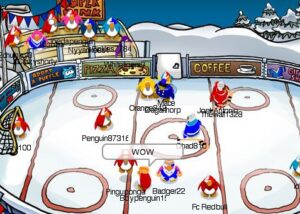
The years around 2008 and 2009 are remembered by many as a defining period of the community. Armies reached unprecedented sizes for the time. But the legacy of this period was not simply measured by battle sizes. It was measured by the children who discovered friendships and the countless players who logged on every day simply because they loved being there.
As the community grew, it needed something more than armies themselves. It needed memory. In 2009, Club Penguin Army Central was founded by Woton, becoming one of the most influential media institutions in the history of the community. It provided news, tournament coverage, statistics, Top Ten rankings, discussion, and a centralized record of what was happening across the army world. CPAC represented an important realization: a community cannot preserve its history unless somebody chooses to record it. The battles that might otherwise have disappeared into the past were documented. The leaders were remembered. Armies were compared in the very first Top Ten rankings. And generations of players learned about the people who came before them. And this is how media became a fundamental part of the community’s institutional memory. The same principle would later inspire many organizations that followed later on.

The years that followed, however, were never simple. There were golden ages and dark ages, there were great wars and disappointing wars. There were moments of cooperation and moments of bitter division. There were leadership crises, controversies, the first multilogging scandals, retirements, revivals, coups, alliances, trophies, reforms, and countless debates over what the community should become.
But through all of it, one characteristic remained remarkably consistent. People kept coming back. The Club Penguin Army community was never defined by one army, one leader, one league, or one generation. It was defined by succession. One generation would build something, another would inherit it, another would change it. And eventually another would rebuild it again. That cycle is perhaps the greatest achievement of the community.
Then came the announcement that seemed capable of ending everything. Club Penguin would close. For eleven years, the original game had been the physical home of the community. On March 29, 2017, Club Penguin shut down. The original era of the Club Penguin Army community came to an end with it. For many players, this was genuinely the end of an era. But it was not the end of the people. The community never forgot to be stubborn. Within days, armies began moving toward private servers. The first CPPS army era emerged almost immediately, with groups continuing their traditions on platforms such as Club Penguin Rewritten and other private servers, like Old Club Penguin and even CPPS.me. While the original game itself had disappeared, the spirit of the community had not. That distinction would become one of the defining lessons of the next twenty years.
Nevertheless, the years after 2017 were turbulent. Without the original Club Penguin, the community became increasingly fragmented across private servers, attempted leagues and news organizations, and server maps that featured many CPPS at once. Club Penguin Rewritten became an important home. Right after, Club Penguin Online became another. New armies appeared, such as the Elite Guardians, Templars, and Help Force, and old armies returned, like UMA, which pioneered the CPPS Era under Ehroyals81/Dillon, and RPF. The Penguin Press, CP Army Syndicate, CP Online Army League, CP Army Media, CP Army Hub, CP Army Headquarters, CP Army Network, and many others each represented attempts to solve the same fundamental problem: How do you keep a community alive when the platform that created it is gone? Now, instead of xat.com, Discord servers became the norm for communication and army organization.
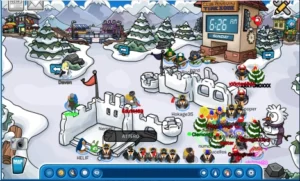
There were also serious controversies. The CPO period in particular produced disputes over corruption, bias, and misconduct. Eventually, a mass exodus from the CPPS led to the creation of the first iteration of Club Penguin Armies, under the leadership of DMT, as well as the creation of the first army dedicated CPPS: Club Penguin Armies: The Game, developed by Superhero123. Club Penguin Online was shut down in May 2020 following a DMCA takedown, creating another existential crisis for armies that had come to depend on it. CPR and CPATG became the norm for the years to come.
Then the world changed. In 2020, as the COVID-19 pandemic transformed everyday life and millions of people found themselves isolated from their normal communities, people returned to places that gave them a sense of connection. For Club Penguin armies, this produced an extraordinary revival. Old veterans returned, new players arrived, armies that had been dormant reopened, and recruitment exploded. And suddenly, something that many people had assumed was gradually disappearing was alive again. The community’s 2020 records show a remarkable number of revived armies, astounding sizes in tournaments, wars, and renewed activity across the army world. The revival was not simply about numbers. It demonstrated something fundamental about the community: The army community was never only about Club Penguin. Club Penguin was the place where it began, but the community was the people themselves.
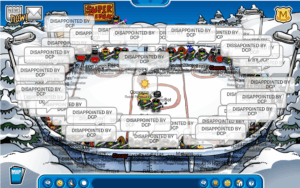
This revival also revealed the limits of fragmentation. By 2021 and 2022, the community was divided among different leagues and organizations, each attempting to provide structure, judging, tournaments, and governance. Ultimately, there were different visions for the future. But eventually, a different idea began to take hold: Perhaps the community did not need another division. Perhaps it needed to come together. In 2022, discussions about unification began, right when the effects of the COVID-19 boom were dissipating, and it all seemed to shrink once more. In early 2022, the judging community took an important step toward reunification, creating a shared judging structure that could serve armies across the divided leagues. These developments helped create the conditions for the recreation of Club Penguin Armies organization later that year, bringing the community’s major organizational structures back under one roof, upon the merger of CPAHQ and CPAN. Carrying this legacy, we face ourselves right here, at the near end of 2026. Finally, we reached the stability and unification that defined the organizations in the OG era.
A MODERN OUTLOOK
Today, twenty years after those first armies appeared, we inherit a community that is almost impossible to summarize. It belongs to the founders who first imagined organized armies. It belongs to the troops who fought the earliest battles in OG. It belongs to the army legends who built legendary armies. It belongs to the journalists who documented every controversy and every triumph. It belongs to the judges who learned how to turn battles into organized competition. It belongs to the graphic designers, recruiters, diplomats, administrators, media reporters and editors, developers, and countless volunteers whose work often happened behind the scenes. It belongs to the people who stayed for ten years. It belongs to the people who stayed for ten days. It belongs to the people who left and returned years later. It belongs to people whose names have become legendary. And it belongs to people whose names history may never record. Every one of them added something.
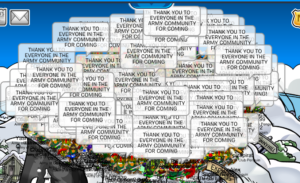
Twenty years ago, the people who created this community could not have known that their experiment would still exist in 2026. They could not have known that battles fought on a children’s virtual island would become memories people carried into adulthood. They could not have known that friendships formed through Xat, WordPress, forums, Discord, and Club Penguin would survive the closure of the game itself. And they certainly could not have known that, twenty years later, another generation would still be sitting together, planning events, debating reforms, organizing tournaments, creating armies, and asking the same fundamental question:
How do we keep this alive?
That is the responsibility we inherit. We are not the first generation. And we hopefully will not be the last. The torch was handed to us by Oagalthorp, Pink Mafias, Explorer7777, Commando717, Person1223, Woton, and countless other pioneers whose ideas established the foundations of this community. It was carried through the golden years by the leaders, soldiers, journalists, and organizers who transformed those foundations into a lasting culture. It was carried through 2017 when the original game disappeared. It was carried through the fragmented CPPS years. It was carried through the controversies and crises. It was carried through 2020 when the community unexpectedly found new life. It was carried through the divisions that preceded 2022. And it was carried into the reunification that brought us here. Now it is our turn.
THE NEXT TWENTY YEARS
An anniversary should not merely ask us to look backward. The people who founded the first armies did not inherit a perfect community. They built one. And that work is not finished. There will be disagreements, controversies, and failures. There will be new platforms, new generations, new organizations, and new challenges that nobody today can predict. It is what happens when a community remains alive. Our obligation is not to preserve every institution exactly as it was. Our obligation is to preserve what made the community worth preserving in the first place. Competition, friendship, tradition, creativity, leadership, and history-making.
To our glorious founders:
Thank you for beginning this.
To the countless veterans:
Thank you for keeping it alive.
To the army leaders:
Thank you for carrying responsibility when it was difficult.
To the troops and community members:
Thank you for filling the servers.
To the media workers and historians:
Thank you for remembering.
To the judges:
Thank you for making competition possible.
To our predecessors in administration:
Thank you for building the institutions that allowed generations to participate.
To those who retired years ago:
Your time here was not wasted.
To those who have returned:
Welcome home.
And to those whose names have been forgotten:
This community exists in part because you were here.
Twenty years ago, they started it. Today, we carry it. Twenty years of people choosing, again and again, to keep the torch burning.
Happy 20th Anniversary to the Club Penguin Army Community.
2006 — 2026
The torch continues.
CPA Aura Era
df44 • Edu14463 • JojoTeri • Kira
More Information

Army Legend. Former Water Ninjas leader. Founder and Former Leader of the Elite Guardians of Club Penguin. Currently serving as Chief Executive Producer in Club Penguin Armies.
*salute*