
Each person’s opinion about bureaucracy in armies is different. While some view extensive rules and regulations as necessary for maintaining order, I believe they often create unnecessary restrictions. In this post, I will explain why bureaucracy is not the solution and why armies should have greater freedom to shape their own outcomes.

Designed by MasterDS
Introduction
Rules have long played an important role in Club Penguin Armies. Over the years, the community has developed regulations governing wars, map claims, invasions, treaties, and many other aspects of army life. These rules often help maintain fairness and prevent disputes and have become a major part of how the army community functions. As the community has evolved, however, the number of regulations has continued to grow, leading to discussions about whether armies are becoming too restricted by bureaucracy. While some members believe that extensive rules are necessary to preserve order, others argue that they limit competition, diplomacy, and the ability of armies to shape their own outcomes. This debate has become increasingly relevant as map and war regulations continue to expand, raising the question of whether bureaucracy truly benefits the community.
Explaining Bureaucracy
When discussing bureaucracy in Club Penguin Armies, most people think of the rules that govern wars and the map. Over time, the community has created regulations covering invasions, occupations, declarations of war, land transfers, treaties, alliances, and many other aspects of army life. Most of these rules began with good intentions, aiming to reduce disputes, prevent abuse, and create a fair environment for everyone involved.
However, as the community introduced more regulations, bureaucracy began to play a larger role in the community. Instead of armies competing solely through diplomacy, military strength, and leadership, they increasingly had to navigate a complex system of rules. This raises an important question: Does adding more regulations actually improve the community, or does it create new problems?
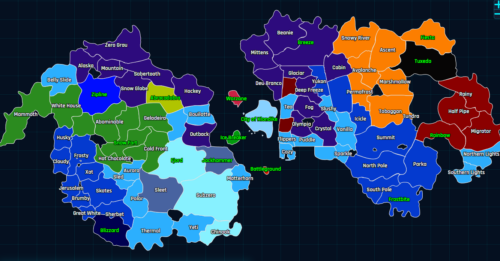
The CPA map is governed by numerous regulations regarding invasions, occupations, and land ownership.
The Problems
One of the biggest issues with extensive regulations is that they often encourage armies to focus on finding loopholes instead of competing directly. Whenever a new rule emerges, armies naturally look for ways to use it to their advantage. Rather than rewarding strategy on the battlefield, the system can end up rewarding whoever understands the rulebook best.
This has happened numerous times throughout CPA history. Rather than letting activity, tactics, or diplomacy determine the outcome of wars, armies often become embroiled in arguments over technical interpretations of the rules. As a result, discussions about regulations can become more important than the actual conflict itself.
Another issue is that excessive rules limit the freedom of armies to make their own decisions. In a competitive environment, leaders should be able to negotiate alliances, make diplomatic agreements, and react to changing situations. However, when too many regulations exist, armies can become restricted by what the rulebook allows rather than what their leadership believes is best.
A healthy competitive environment should encourage creativity. Leaders should earn recognition for making smart decisions, not for perfectly following a lengthy set of procedures.
The more rules that exist, the more enforcement is required. Every regulation creates the possibility of disputes, investigations, and appeals. Instead of armies resolving disagreements themselves, they become increasingly dependent on outside intervention.
This can lead to situations where conflicts are settled by administrators and regulations rather than by the actions of the armies involved. While some oversight is necessary, too much reliance on enforcement can weaken the competitive aspect of the game.
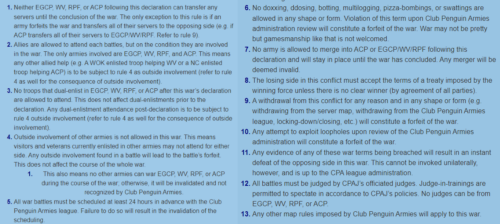
War declarations often contain numerous terms and restrictions, increasing complexity and creating opportunities for disputes over interpretation.
A Better Alternative
This does not mean that all rules should be removed. Basic regulations are necessary to prevent abuse and maintain fairness. However, the community should focus on simplicity rather than constantly adding new restrictions.
Instead of creating a rule for every possible situation, armies should be given more responsibility to solve issues through diplomacy, negotiations, and mutual agreements. If an army makes poor decisions, it should face the consequences naturally through wars, damaged relations, or lost alliances rather than relying on an increasingly complex regulatory system.
The strongest communities are not the ones with the longest rulebooks. They are the ones where members have the freedom to compete, innovate, and shape events through their own actions. For that reason, bureaucracy is not the solution. A simpler system built on trust, diplomacy, and accountability would create a more dynamic and engaging CPA community.

The best solutions come from communication between armies, not from expanding the rulebook.
The Final Decision
Ultimately, the future of bureaucracy in Club Penguin Armies is up to the community and its leaders. While rules are necessary to maintain fairness, adding more regulations is not always the answer. In my view, armies should have greater freedom to compete, negotiate, and shape their own outcomes. A simpler system focused on trust, diplomacy, and accountability would make CPA a more dynamic and enjoyable community. For that reason, I believe that bureaucracy is not the solution.
What do you think about bureaucracy in CPA? Do the current map and war regulations help the community, or have they become too restrictive? Should armies have more freedom to shape their own outcomes? Make sure to share your thoughts.
GeoIonut
Senior Reporter