Welcome to This Day in History, a column that examines intriguing moments in army history. In this edition, we will discuss the events that occurred on April 20.
Designed by Master DS
2014-2015 LEGENDS INDUCTIONS
April 20, 2014
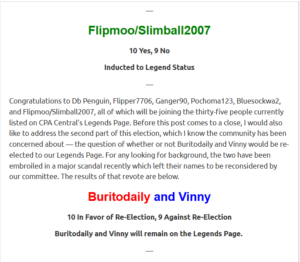
The April 2014 Club Penguin Army Central Legends Committee completed the Legends Inductions after several days of deliberation and public voting, adding new members to the CP Army Legends page. The process used a 20-member Legends Committee, with each member casting one vote per candidate, alongside a public vote component that carried equal weight, though no candidate achieved induction solely through viewer votes in this cycle. The committee evaluated a total of 25 contenders spanning different eras of Club Penguin Army history from 2006 onward. Committee regulations required a majority of 11 out of 20 votes for induction, or 10 out of 19 in cases of abstentions due to conflicts of interest. Candidates who were also committee members received automatic abstentions and were scored using altered voting thresholds.
Bluesockwa2 (11-8), and Flipmoo/Slimball2007 (10-9), with the latter two, as well as Flipper7706 and Ganger90, inducted under adjusted or tied vote conditions when applicable regulations permitted admission. Flipper7706 and Ganger90 both received 10-10 splits and were later waived to Legend status. Other important figures, such as Sf1998, Gu Gu Pengu, Kenneth1000, Dreamguitar, Kingfunks4, and Zakster, did not meet the needed threshold, with several earning significant No majorities despite their previous historical significance in the community. In addition to ordinary inductions, the committee held a separate revote on Buritodaily and Vinny’s standing due to previous disagreement. The result of this revote was 10 in favor and 9 against, so both figures remained on the Legends Page.
April 20, 2015
The April 2015 CPAC Legend Inductions concluded after a nine-day voting period that combined nearly 100 public votes with the deliberations of a 20-member committee, producing a final decision on two new additions to the Legends page. As one of the most prestigious recognitions within Club Penguin Armies (CPA) history, the CPAC Legend title continues to represent long-term influence, competitive success, and lasting contributions to the broader warfare community dating back to the early era of armies in 2006. Each induction cycle recognizes individuals and also records figures who shape the evolution of organized army conflict and leadership culture within the game.
The selection procedure is thoughtfully designed to integrate community feeling with official consideration. A 20 member committee; 14 of whom are already CPAC Legends casts individual votes, while public feedback factors equally, often serving as a deciding element in strongly debated cases. Candidates for this cycle represented different generations of CPA history, from early-period personalities like Gu Gu Pengu and Johanwillfir (2007 era) to later contributions like Mustapha10 and Andrew24 (approximately 2015).
When the committee completed the votes, the results showed a mix of close approvals, tied outcomes, and decisive rejections. Gu Gu Pengu earned induction with 11 Yes votes and 9 No votes, while Sklooperis also earned induction with a 10–10 split. Johanwillfir, Dreamguitar, and Mustapha10 did not meet the threshold for induction, as each received a majority of No votes, with Mustapha10 also receiving a +1 viewer vote distinction.
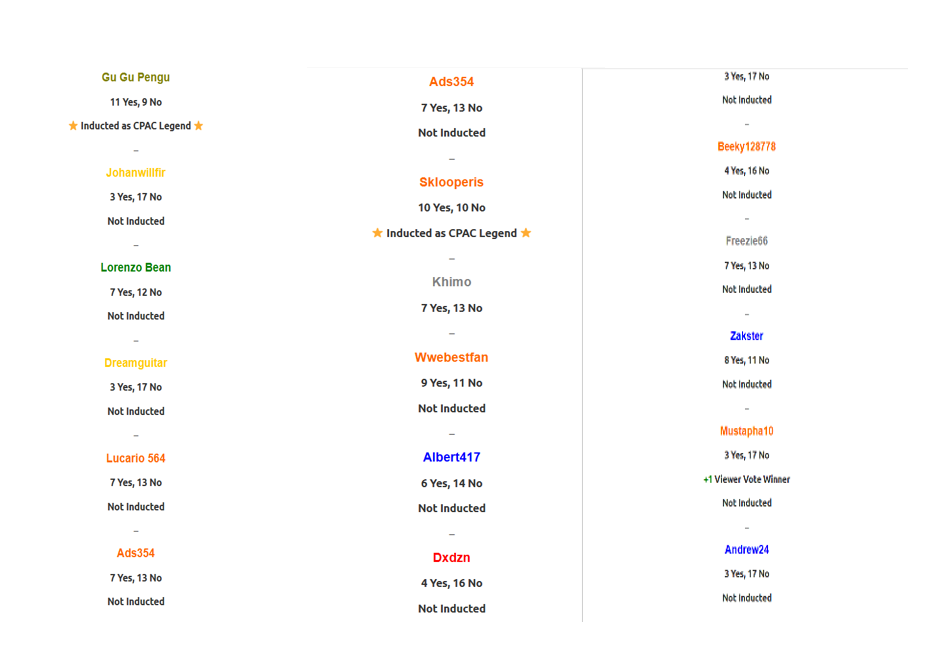
List of figures inducted and not inducted as Legends. Please click to enlarge.
Golds Declares War On Rebels
April 20, 2014
On April 20, 2014, the Golds declared war on the Rebel Penguin Federation, following internal leadership changes that included the dismissal of Taco Daily and the appointment of Freezie66 as leader. The announcement came after the Golds’ improved performance, which included a tournament victory over Underground Mafia and an increase in CPAC standings. Gold’s leadership framed the conflict as a challenge to the top-ranked RPF, claiming allegations of unjust leadership methods and stating a desire to place themselves among the main armies.
Light Troops Response
In response, the Light Troops, ranked fourth on CPAC at the time, declared war on the Golds, escalating the situation into a broader conflict involving multiple armies and shifting alliances. The Light Troops formally issued their statement on April 20, 2014, in which they outlined both their justification for the war and a detailed invasion schedule. The LT leadership stated that Golds surpassed them in CPAC standings and targeted their allies, including the Rebel Penguin Federation, as key reasons for the declaration.
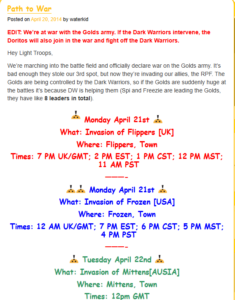
Post by Waterkid announcing the “Path to War” declaration, outlining the war against the Golds and listing the scheduled invasion dates and targets across multiple servers.
The LT post also claimed that the Golds operated under the influence of the Dark Warriors and raised concerns about their leadership structure, specifically referencing Spi and Freezie as central figures within a multi-leader system. The invasion schedule listed coordinated attacks across several servers, including Flippers, Frozen, Mittens, Sherbert, Snow Flake, Slippers, Ice Bound, and Fog, spanning UK, USA, and AUSIA divisions between April 21 and April 25. This plan demonstrated a structured, multi-day offensive campaign.

The Light Troops Invade Frozen – 21 April 2014
Golds leadership, represented by Final Chaser, framed the conflict as a challenge to RPF dominance and expressed confidence in achieving strong event sizes and competitive performance. LT leadership, represented by Waterkid100, defended the war declaration by citing Golds’ actions against RPF and alleged external influence within Golds’ organization. At the time, the Rebel Penguin Federation had not issued an official response, despite circulating claims regarding altered messages.
CONCLUSION
All things considered, April 20 is notable in CPA history as a day of both acknowledgment and conflict, with significant war declarations taking place concurrently with the organized Legends Inductions that chronicled and protected long-term legacy. The 2014–2015 induction cycles, in particular, demonstrated how historical impact was properly assessed and documented, reaffirming the Legends system as an essential component of maintaining army history despite continuous military and political disputes within the community.
MtJordan II
Associate Editor
More Information

you look like fridge