
‘What If’ is a space for curiosity without fear and imagination without apology. In this column, we explore possibilities, some practical, uncomfortable, or ambitious, to ask how things could be different in the army community. Today, we will ask ourselves: What if World War IX had not ended with a peace treaty?

Designed by Kedi Wain
Officially started on June 1, 2023, World War IX was initiated with the Blue Sunset Alliance, comprising the Rebel Penguin Federation, Water Vikings, and Elite Guardians, jointly declaring war on the Army of Club Penguin. The alliance accused ACP leader Calgocubs21 of having an aggressive expansionist character. Therefore, the alliance was formed as a maneuver to hinder ACP’s obsession with ‘fully conquering the army community’, as stated by RPF Leader Link3000, and aggressive behavior.
The seemingly one-sided conflict soon blew up once the Club Penguin Armies Administration declared the no-allies war term invalid. Thus, the original Operation: Domination escalated to become a World War. The Sapphire Concordat alliance, comprised of the People’s Imperial Confederation, Special Weapons and Tactics, Templars, and Napalm Corps, came to the aid of ACP. Later, the Help Force would indirectly join the conflict by supporting the Clovers, their brother-allies. The first official battle of the war, the invasion of Alabama, turned out to be the biggest battle of the year, with 120+ penguins online.

June 2, 2023: Sapphire Concordat invading Blue Sunset Alliance’s Alabama; BSA victory
After PIC and NC were force-treatied, leaving the war due to losing their capitals, there was a period of relative peace, with both sides refraining from scheduling more invasions. The only exception was TCP, who tried to reclaim Moscow from the Guardians but suffered another defeat.
The World War would then come to an unexpected end on June 13. The conclusion of the conflict surprised many, as the war had a rather one-sided nature. Despite the BSA impressively winning all 32 battles, the Sapphire Concordat still had approximately 100 servers under its control. For that reason, the war was expected to continue for weeks, if not months. Leaders from both sides came together to sign a peace treaty, formally ending all hostilities and controversially declaring the war as a tie. And to top it all, RPF mistakenly broke the third term of the treaty, losing all of its land to SCA.
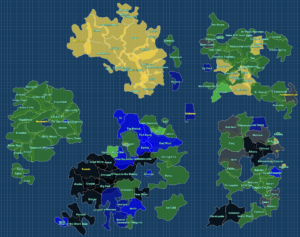
Servers Map at the end of World War IX: Army of Club Penguin – Dark Green. Elite Guardians – Dark Grey. Help Force – Blue. Rebel Penguin Federation – Black. Special Weapons and Tactics – Lime Green. Templars – Yellow. Water Vikings – Navy Blue.
But what if the Blue Sunset Alliance refused to cede and kept fighting?
As a former advisor of the Blue Sunset Alliance, I can attest that, after forcing PIC and NC out of the war, our next strategic objective was to target SWAT and capture their capital, thereby removing another Sapphire Concordat force from the conflict, as they were already reduced to only three or four servers. With SWAT eliminated, the Concordat would have been left solely with ACP and TCP as its remaining major forces. Additionally, by the final days of the war, SCA’s overall size had dropped significantly. While BSA also experienced a reduction in numbers, the alliance managed to maintain a stable and competitive average, sufficient to continue defeating its opponents. In light of this, it is reasonable to conclude that BSA possessed the capacity to sustain the war for several additional days.
Under the condition that an army cannot be invaded more than once within the same time zone (EU and US were considered the same time zone back then), the continuation of World War IX would have quickly shifted into a war of attrition. With WV, EGCP, and RPF each capable of launching up to two invasions per day, the Blue Sunset Alliance could theoretically sustain four successful invasions daily, allowing the conquest of the remaining 90 servers in roughly 22.5 days under ideal circumstances.
However, once ACP and TCP are factored in, each launching two daily counter-invasions that are ultimately lost, but still demand defensive responses, the offensive capacity of each BSA army would effectively be reduced by one invasion per day. This would lower the alliance’s total invasion output to three successful invasions per day (as invasion times would overlap, thus ruling one of them as invalid), extending the projected duration of the war to approximately 30 days. In practice, time zone limitations, scheduling friction, and leadership fatigue would likely reduce that average even further, pushing the realistic timeline closer to 35–40 days. Thus, even failed counter-offensives by ACP and TCP would have significantly prolonged the conflict, reinforcing that the longer the war continued, the more time and endurance would dictate its outcome.

Therefore, it becomes clear that the war was ultimately destined to end through fatigue. Armies would probably end up being reclassified to S/M due to low size averages. Legends Cup XIII would end up with a different schedule or even have a different outcome… Anyway, back to theorizing. Troops and leaders are not machines, but individuals with real-life responsibilities that inevitably outweigh the online obligation of attending repeated 30-minute invasions or enduring daily 10-minute no-shows over an extended period. As exhaustion set in, ACP and TCP would have gained the time and breathing room necessary to recover, reorganize, and eventually counterattack a Blue Sunset Alliance weakened and increasingly fragmented by burnout.
Alternatively, had BSA continued to operate at full capacity despite the strain, the Help Force might have been compelled to enter the conflict directly, further intensifying the pressure placed upon the alliance. In either scenario, a peace treaty would have remained the most plausible outcome. However, had BSA pressed forward for a short while longer, it is possible that the terms of such a treaty would have been more favorable, avoiding the controversial tie declaration and the inclusion of score wipe clauses.
To conclude, other possibilities could be factored in. Usually, extended wars often expose structural weaknesses within alliances. Prolonged pressure could have led to disagreements inside either BSA or SCA regarding leadership decisions or acceptable losses. Even a partial withdrawal from one member army could have altered the balance of power and accelerated a push toward negotiations. From the BSA side, WV was the driving force pushing to end the war due to exhaustion. TCP would most likely also push for the war to end, as ACP, who was pulling all the strings since the beginning, would be less likely to accept a defeat.
Wars are fought not only on the battlefield but also in perception. As the conflict prolonged, public interest could have waned, or narratives could have shifted against whichever side appeared to be prolonging the war unnecessarily. BSA started the war to fight against ACP’s aggressive domination plans. Ironically, the alliance would become what it was formed to combat. Losing narrative dominance often accelerates diplomatic pressure, regardless of win–loss records.
Perhaps the most important outcome is that RPF would never break that damn treaty term. Do you think anything could have gone differently?
Edu14463
Chief Executive Producer
More Information

Army Legend. Former Water Ninjas leader. Founder and Former Leader of the Elite Guardians of Club Penguin. Currently serving as Chief Executive Producer in Club Penguin Armies.