Each person’s opinion about the war declaration terms, whether on the map or not, is different. In this post, I will examine one that I believe adds unnecessary bureaucracy: the forced 1 versus 1 war term.

Designed by MasterDS
Introduction
The map rules have been the center of discussion for a while. During the Autumn, Club Penguin Armies hosted the Mapping the Map summit, where army leaders and community members could share their thoughts and vote on the map rules. Through the summit, all map rules were discussed, while a majority of them were revised. Each active non-meme army had one army representative, who voted on the rules that were discussed in each session. Additionally, the public was also able to vote, but their vote counted as 1. People’s opinions were different, usually, with arguments often taking place, with each side trying to support their view. Usually, the community and the rep votes chose the same option, but there were times when they disagreed.
The 1 versus 1 rule
One of those revoted and revised rules was the 1 vs. 1 war term, as well as the allies and visitors battle involvement, which goes on par with it. I wanted to share my thoughts on that rule and its enforcement for a while, but given that some Army Board members requested its revote, now is the perfect occasion for this post. To provide the necessary context to those who may not be aware, the Army Board consists of one army leader per army that has hosted events for four weeks in a row. So basically, every consistently active army has a representative there.
During the summit, the 1vs1 war rule was completely removed, meaning that currently, CPA does not enforce it if it is added in a declaration. During the vote for it, the representatives voted 10 in favor and 4 against the removal of the rule. Along with this rule, terms that did not allow specific groups of the community to attend were also no longer enforced. At the same time, 40 community members voted in favor of the removal, and 10 against, mirroring the representatives’ choice. But what did that term state, and how did it affect battles?
Explaining the Rule
When the term was invoked in a war declaration, no other armies were allowed to declare war on either of the participants. This basically meant that the two armies were locked out of outside wars and remained in their own “bubble”. At this point, it should be mentioned that the rule was only enforced on wars taking place on the map. Along with that term, there was another one. The extra term prohibited a specific group, based on the wording, from attending the battles. Usually, that was the dual enlisted people, visitors, and allies. This means that someone who was enlisted in the army and advising another was not able to attend.
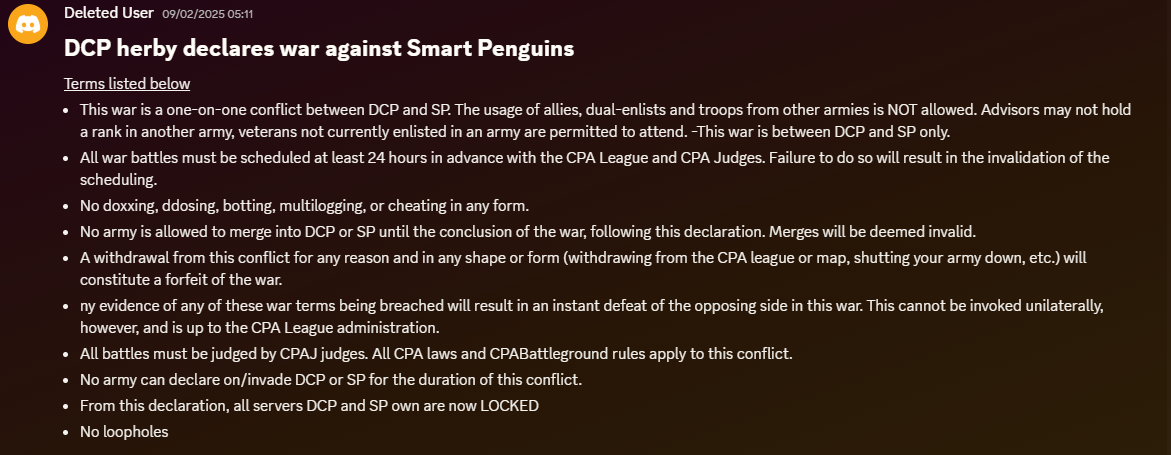
A War Declaration Invoking the 1vs.1 War Term
The Problems
1 Versus 1 Term – Loopholes
The terms sound good in theory, but in practice, it is a nightmare. Of course, there were some times when everything worked as intended. When armies used the term in their favor to isolate an army from its allies and face it in a 1 vs. 1 war. At the same time, armies tried to find loopholes through the term. There were occasions when two armies declared a fake war between each other to maintain their land without risk. They scheduled invasions a few times per week to keep the war active, no showing most battles. An example of that could be the Winged Hussars’ war against the Elite Guardians of Club Penguin, so that neither of them can be invaded.
Similarly, armies have used the term in order to trade land with each other. This way, they were able to bypass the non-hostile land cap without being intercepted by an outside army. This shows that there were many ways to loophole through the term. Armies were able to use it in their favor, to gain more land, or maintain their currently owned land without any risk. It increased the number of wars, but only in name, as some of them weren’t actual ones. The map was not so much based on battlefield skill, but rather on who could use the rules to their best advantage.
1 Versus 1 Term – Technical
Apart from the multiple loopholes, there was a technical issue as well. The 1 vs. 1 war term allowed major armies to freely take on Small/Medium ones. This can still happen, but with the term’s existence, it was easier to accomplish. Major armies were just able to isolate SM armies and take their land 1 by 1. On the other side, SM armies were left to face a Major one alone, without being able to call any allies to assist them.
The result was the SM armies being unable to remain on the map for more than a few months, while Majors were able to build an entire empire after having taken their land. That way, it was more difficult for armies with ‘honor’, who did not want to take SM land, to face the others who already had many servers in their ownership. The community did have more wars, but many of them were no-shows as the SM armies were unable to match the Major ones.
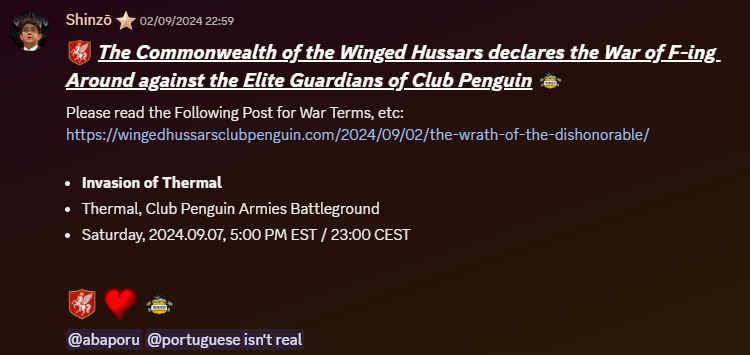
WH Declaring War on EGCP
Exclusion of People – Loopholes
The second term, the removal of outside interference, also had issues. While it was often set simply as “no allies, dual enlists, visitors”, sometimes it became more complicated. There were times an army allowed a specific group of people, for example, dual enlists, or allies, if they had many of them, to attempt to gain an extra advantage. This created a weird situation, where in many cases, armies had to ask if a person was allowed to attend the war. This only became worse in some wars, when armies worded the term in some specific ways.
For example, there was a war in which, based on the declaration, dual enlists were not allowed unless they were veterans of the army. This created a weird situation where some enlisted people could attend while others were not allowed to. This further intensified the need for the armies to ask if someone was allowed to attend the battles. It ended up at a point where army warfare became too complex when it came to the allowed attendees. This was solved at the summit, with the removal of the term.
A Middle Ground Solution
There is still a way to have the 1vs.1 war while not making things very complicated or risking armies loopholing through the terms. This would be done by removing CPA’s intervention when it comes to this rule. Instead, armies would enforce it themselves. This way, all the unnecessary bureaucracy would be removed. It would be up to the armies to decide if they wish to enforce it or not on a case-by-case basis.
For example, if an army felt that another one is using a loophole in the term to their advantage, they could enter the war against them. Or, if a Major army starts declaring back-to-back 1 vs. 1 wars against SM armies in order to gain more land, a different Major army could step in to stop them. That way, it can be up to the participating armies themselves to decide if the term gets enforced or not. If both armies agree to enforce the 1 vs. 1 rule, then so be it.
A similar process could be used for the second part of the rule, the exclusion of some people. It could also be decided by the armies involved in the war, in a way that they deem the most fair. Through this, wars will become more strategic and intense. Communication will be important, and the loss of it will lead to escalations of the wars. Of course, if an army calls its allies all the time, it will hurt its virtue, as it is not an honorable decision during a 1 vs. 1 war. Honor in armies is important, as one can lose alliances and friendships by committing dishonorable acts.
On Par With the Traditional War Terms
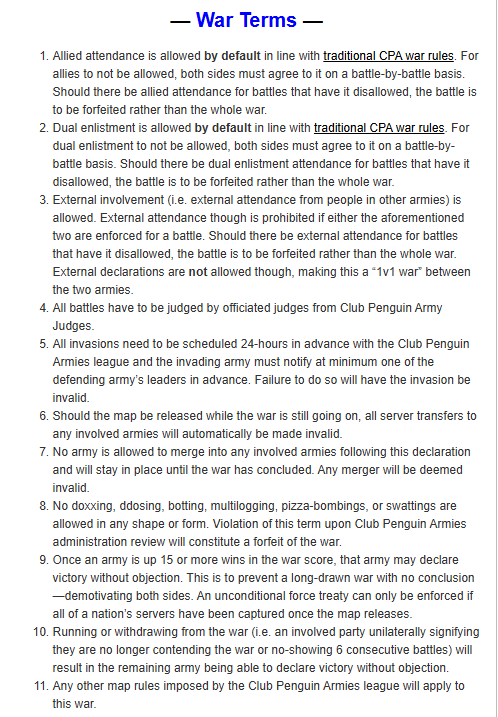
WV War Terms in their Declaration on TCP
This solution goes more in line with the Club Penguin Army Council 2013 decision on how wars and war declarations should be. Believe it or not, many of the current war rules originate from that decision. In their post about the War Rules, the following is written regarding the 1 vs. 1 rules, which is also linked in the Water Vikings declaration above:
Clause 1: No Allies Rule
The No Allies Rule can be implemented only when both the invading and defending armies agree. If both armies agree to a no-allies battle, any proven use of allies by either side merits immediate disqualification, and victory is awarded to the other army. The No Allies Rule also applies to proven loaning of soldiers in the case that they dress up as members of the invading or defending armies. If the No Allies Rule is not agreed upon by both armies, allies may be used by either side.
The Final Decision
The final decision, though, is up to the Army Board, which will be meeting soon to discuss about this term and some other ones that concern it. No matter what its choice will be, CPA will be glad to apply it. We hope that through this requested meeting, the map will end up becoming a more desirable tool for the active armies. The general community, which is not part of the Board, will be made aware of any rule changes, if any, when they are applied, with the army leaders finding out a bit earlier.
What do you think of the 1 vs. 1 term and the exclusion term that comes with it? Should it be brought back? Which layout should it follow if it returns? Make sure to share your thoughts.
Jojo Teri
Chief Executive Producer
More Information

Professional Club Penguin player