
The recent lack of wars and general lack of the “army” element in armies has troubled the Army Legend and Templars Creator Xing. In this post, he tries to analyse and explain this issue from a philosophical and historical viewpoint.

Designed by Master DS
The Diagnosis: Armies Without Enemies, Systems Without Life
The Philosophical Idea
In the later years of the Roman Republic, decline did not announce itself through chaos or visible collapse. Instead, it emerged through a narrowing of competition among those who held power. Rivalry gradually gave way to quiet coordination, as leading factions began to preserve one another rather than test one another. This created a system that appeared stable while steadily losing the energy that had once sustained it. Thucydides observed a similar pattern, noting that alliances among dominant actors can suppress open conflict while weakening the system beneath the surface. Aristotle echoed this idea, arguing that political balance depends on opposing forces that check one another, rather than collapsing into a single dominant structure.
Comparison to the Army Community
This same pattern now defines the army community. The Rebel Penguin Federation, Help Force, Army of Club Penguin, and the Water Vikings have formed a bloc so expansive that it removes the existence of meaningful opposition. The result is a landscape in which armies no longer define themselves through rivalry, but through alignment. In doing so, they lose the very conditions that once gave them purpose. An army that does not face resistance cannot meaningfully claim strength, and a system that does not permit contest cannot meaningfully claim vitality. The implications of this structure become clearer when viewed through the behavior of power once it no longer needs to prove itself. The Club Penguin Armies map has ceased to function as a reflection of competition. Instead, it stands as a representation of consolidation, where influence is stabilized through coordination rather than contested through conflict.
Historical Parallelism
This transformation parallels the concerns raised by Polybius, who warned that when a republic drifts into oligarchic concentration, it loses the internal tensions that sustain it. Plato further illuminated this dynamic, describing how systems that prioritize preservation above all else gradually degrade into forms that lack both excellence and dynamism. Within the army community, this degradation is visible in the way armies operate within fixed boundaries defined by the alliance. Rather than pushing against those boundaries through competition, they remain confined within them. The result is a static environment in which outcomes are shaped before conflict can even occur, and where the absence of challenge signals not strength, but exhaustion.
The Diagnosis
What emerges from this condition is not peace, but inertia. The removal of rivalry does not eliminate ambition, but confines it within a system that cannot accommodate it. Later thinkers such as Niccolò Machiavelli identified this dynamic as fatal to republics, because ambition that is denied legitimate expression becomes constrained and eventually destabilizing. Within the army community, this constraint is evident in the way armies seek security within the alliance rather than risk outside it. Alignment is prioritized over independence, and stability is valued over strength. In doing so, the very nature of what it means to be an army is transformed. The pursuit of dominance has been replaced by the maintenance of position, and the drive to compete has been replaced by the need to conform.
The diagnosis is not difficult to state, even if it may be difficult to accept. The army community has not evolved into a more stable form, but has declined into a less competitive one. The alliance between these dominant armies has created a monopoly that suffocates rivalry. This suffocation has removed the conditions necessary for the community to remain dynamic. Systems do not survive by eliminating conflict. They survive by channeling it. When that channel is closed, what remains is not strength, but stagnation that preserves itself only by preventing anything from challenging it.
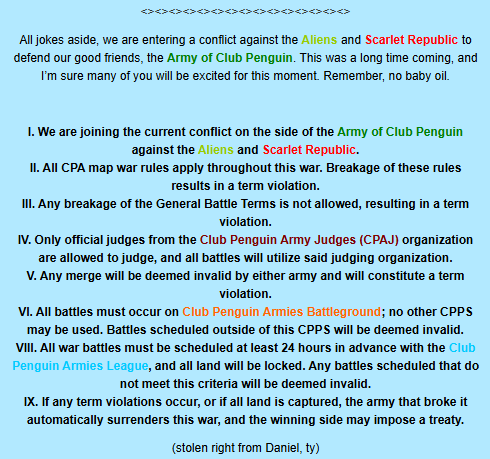
The Indictment: Virtue as Pretext, War as Performance
Historical Comparison
As competition narrowed in the late Republic, the nature of conflict itself began to change. It shifted away from direct confrontation and toward justification. Political actors increasingly framed their actions in the language of necessity and virtue. Thucydides captured this transformation when he described how words lose their meaning once they are used to mask power rather than reveal it. This same pattern now defines warfare within the army community. Conflict no longer emerges organically from ambition or rivalry. Instead, it is preceded by the construction of a narrative that renders it acceptable. Armies search for wrongdoing that can serve as a pretext for engagement, subordinating action to justification. War becomes something that must be explained before it can be fought. In the process, it is stripped of the immediacy and consequence that once made it central to the community’s identity.
Effect on the Army Community
This shift carries deeper consequences than a simple change in tone. It introduces a standard that cannot be consistently upheld. Every army possesses a history that can be scrutinized and reframed as wrongdoing. The result is a condition in which accusation becomes universal and claims to moral authority become unstable. Socrates warned against the use of virtue as a rhetorical instrument rather than a genuine standard. That warning finds clear expression here. Within the army community, this misuse has produced a culture of mutual vulnerability. No actor can move without exposing themselves to counter accusation. The result is not accountability, but hesitation. Leaders recognize that any action taken will invite scrutiny that extends beyond the battlefield and into the realm of reputation.
The Result
From this hesitation emerges paralysis. It reflects the cycles described by Herodotus, in which societies become trapped in patterns of accusation and counter accusation that prevent decisive action. Within the army community, this paralysis appears in the reluctance to engage in meaningful conflict. Wars are avoided not because they lack purpose, but because they have become too costly in ways that extend beyond competition. The search for justification functions less as a moral safeguard and more as a barrier that prevents action altogether. Warfare is reduced to a controlled performance that affirms existing structures rather than challenging them.
Leadership adapts to this environment in ways that further entrench the problem. Those who might once have acted decisively now operate within a framework defined by caution. Every decision must be weighed against its potential to provoke backlash. Machiavelli warned that leaders who prioritize preservation over action ultimately lose the capacity to lead. That concern is visible here. Within the army community, leaders are transformed into managers of stability rather than agents of ambition. They navigate alliances and reputations instead of pursuing dominance. In doing so, they reinforce a system in which war becomes performance, and leadership becomes administration.
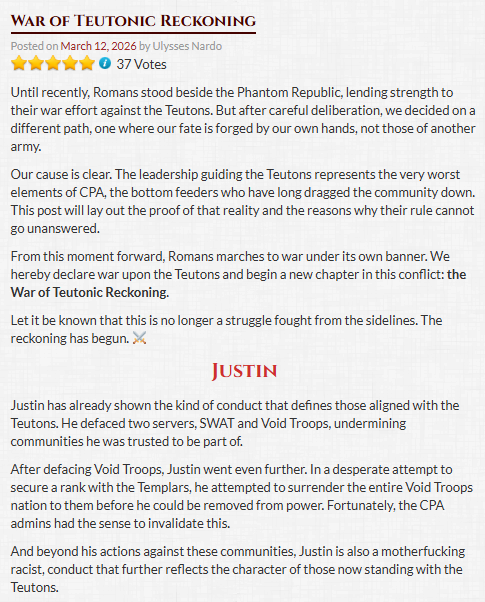
A Part of the Romans Declaration on the Teutons
The Consequence: Stagnation, Weakness, and the Loss of Identity
Lack of Competition
When systems cease to compete, they do not remain static in strength. Instead, they decline in substance. Xenophon recognized this principle, observing that groups deprived of challenge lose discipline over time, because strength is maintained through testing rather than preservation. Within the army community, this loss is evident in the diminishing role of strategy, in the repetition of events that lack consequence, and in the absence of rivalry that once gave armies their identity. Competition has been replaced by coordination, and ambition has been replaced by caution.
This decline is not merely structural, but psychological. The avoidance of conflict produces a culture that fears disruption more than it values growth. Epictetus emphasized that adversity is necessary for development and that refusing to confront challenge leads to weakness. Within the army community, this refusal has created an environment in which armies no longer face the pressures that once forced them to adapt. The result is a landscape that appears stable but is fundamentally diminished. Participation continues, but it lacks intensity. Identity becomes increasingly difficult to sustain without the presence of meaningful opposition.
The Consequences
Even the map, once a symbol of dynamic rivalry, now reflects this stagnation. It remains largely unchanged, not because conflict has resolved itself, but because it has been prevented from occurring in ways that would alter the structure. Marcus Aurelius reflected on the necessity of engagement with challenge, understanding that systems must confront difficulty in order to maintain their strength. Withdrawal from such engagement leads to decline. Within the army community, this withdrawal is visible in the preference for stability over competition and in the gradual erosion of the qualities that once defined participation.
The consequence is a community that continues to exist but no longer functions as it once did. Armies remain present, but they lack purpose. Conflict remains possible, but it lacks meaning. The very structures that preserve stability simultaneously undermine vitality. What emerges is a condition that mirrors trajectories observed in antiquity, where systems that eliminate competition in favor of preservation ultimately preserve nothing but their own decline.
The Cure: A Caesarian Break Against Monopoly
A Look at History & Its Application to the Army Community
History does not offer gradual solutions to conditions such as these. Systems that have become this consolidated do not reform themselves from within. Instead, they require disruption. This principle is demonstrated in the actions of Julius Caesar. His crossing of the Rubicon did not create instability, but exposed the instability that had long been contained beneath the surface. It forced a confrontation that the existing order could no longer avoid. In doing so, it restored the role of decisive action within a system that had grown incapable of accommodating it.
The same necessity now presents itself within the army community. The alliance system has produced a structure that cannot sustain genuine competition. At the same time, the culture of moral justification has made action increasingly difficult. The result is a condition that demands not adjustment, but rupture. What is required is a break from the constraints that define the current order, along with a reintroduction of rivalry as the central force that drives engagement. Without such a rupture, the system will continue to preserve itself in a diminished form.
The Cure
Such a rupture requires the emergence of a figure or group willing to act outside the established framework. This actor must reject the idea that justification is a prerequisite for conflict. They must also challenge the monopoly that has formed. This kind of action would provoke resistance from those invested in the current structure. Yet that resistance is precisely what restores meaning to competition. It reintroduces stakes, uncertainty, and consequence into a system that has lost them. In doing so, it forces armies to define themselves once again through rivalry rather than alignment.
The cure, therefore, lies in the restoration of contest. It must come through confrontation rather than coordination, and through disruption rather than preservation. Only through such a transformation can the army community recover its vitality. Only through such a break can it escape the pattern observed throughout history, where systems that suppress competition in the name of stability ultimately sustain nothing but their own decline.
In this post, Xing has tied historical information and philosophical beliefs to the army community’s war and competition drought. Do you agree with his beliefs? Can there even be a philosophical comparison, and is history relevant when it comes to the armies? Let us know what you think.
Xing
Army Legend & Templars Creator
More Information

Professional Club Penguin player